Mercruiser 140 with water in oil, low compression

jpitts

Member
Joined
Jun 11, 2001
RO Number
4931
Messages
18
We have a 1984 Caravelle with a Mercruiser 140 engine. This is the 4 cylinder GM engine, with an Alpha 1 outdrive. The engine serial number is 6045155. This boat has been in the “family" since 1986. It was owned by a close friend until 95 when I bought it. I sold it back to the friend in 2005, and last month he sold it to my brother. When he sold it to my brother he said it wasn't running well, and he had paid for a tune up that did not cure the problem.

We took the boat out to the lake. It was hard to start, but it started eventually. After running it for a few minutes we noticed that the vent hose from the valve cover to the carburetor had slipped off the carb, and there appeared to be a lot of steam coming from the hose. After a few more minutes these steam started looking like a brownish oily mix, and we went back to the dock. We went home and changed the oil. The oil was a brown watery mess.

I suspected the problem was the exhaust/intake manifold. I know that I replaced the riser some time in the early 2000's, but the exhaust manifold has never been changed. But I also thought it could be cracked block or something else, so we ran a compression test. We warmed up the engine, and did the test. We got dry compression values of (starting from the front of the engine) 55, 125, 105 and 150. We then added a bit of oil to the first cylinder and the compression value jumped up to about 65.

One more thing-when we were doing the compression test we noticed that there was a decent amount of what looked like water squirting out spark plug hole of the back cylinder.

At this point we are not sure what to do. My best guess is that we have a leak in the exhaust manifold somewhere near the back cylinder. I am inclined just to replace the exhaust manifold and see what happens. I have another boat that had low compression in one cylinder and that boat has ran just fine for 10 years.

The boat does not have a lot of value. I am not sure what it would cost to fix the low compression, but it might exceed the value of the boat. OTOH, it is a fun little boat when it is running well, and given how much we use it, the engine might last a long time just like it is.

So what should we do? Should we just replace the exhaust manifold and see what happens? Or is it foolish to not deal with the compression issue at the same time? And should I replace the riser again?

Jared
 
Water in the engine probably blew the head gasket or something else. IMO you need to pull the head. First put oil in the cylinders and turn the engine over by hand to prevent the rings from freezing. Since you are not in salt water you may get lucky. Off with the head ASAP
 
Thanks for the reply. I never even considered a bad head gasket.

We are not in salt water.

Would the bad head gasket explain both the low compression and the water in the oil? But what about the fact that it is the front cylinder that has low compression, but it is the rear cylinder that has water squirting out during the compression test?

And would you still replace the manifold and/or riser when you did the head gasket?
 
Yes lo comp is often sign of head gasket. Partial compression can be many things that will become apparent. Don't bother buying manifold just yet.
 
If "all" it is, is the Head Gasket, you could actually be pretty fortunate. Much less UNfortunate than cracked block, rusted-out block or head, etc. You very likely DO need some exhaust parts, given of course the engine itself is repairable. But if the engine IS repairable, you can come out of this with a running boat again.

Head gasket failure of course loses compression in affected cylinder(s), but it often opens up water an oil passages as well, leading to water in the oil.

If you find a failed gasket, don't just replace it. Take the head to an auto machine shop for inspection, leak testing, valve job and re-surfacing. There may be new or reman heads available. Just be sure everybody understands it's a marine application for parts and gaskets.
 
Thanks for your replies. But I have some questions.

First, I don't understand why you would assume that it is a bad head gasket and not just a bad exhaust manifold?

As I pointed out in my initial post, only the front cylinder has low compression. And even that is not super duper low. And only the back cylinder appeared to have water squirting out when doing the compression test. So why couldn't be that the we have a leaking exhaust manifold near the back cylinder of the engine--- and that is the source of the water in the oil? And why couldn't the low compression be a leaking valve in the front cylinder?

Is it not true that a rusted out exhaust manifold can get water in the engine oil? Given that this exhaust manifold is over 30 years old wouldn't that be a likely source of the water?

So again, what is it that makes you think head gasket first?

A couple of other things-- we are in Arizona, and it does not get cold enough hear to crack a block from bad winterizing. I guess my friend could have overheated the boat and blown the head gasket, but even he probably would have told me.

Finally, I should add that we only paid 500 for the boat. We are not opposed to a do-it-yourself head gasket replacement if that is really necessary, but spending tons of money on this thing is not really in the cards-- we would probably just part it out and keep the trailer first.

Thanks

Jared
 
Exhaust manifold does not reduce compression
It may be bad but probably caused other problems.
 
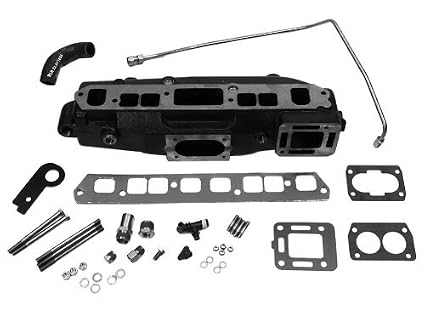
412DUMQWk4L._SX425_.jpg
If this is your exhaust manifold... Actually if it's your Manifold... the Carburetor sits over the large rectangular opening in the center, and the square opening on one end, with the four slots, one on each edge, is the exhaust.

OK, if that's the correct picture, exhaust is at one end, the rear cylinder. Square hole is exhaust, four slots are water passages. It's called a Wet Joint. What usually happens is the surfaces of the manifold and/or the matching area of the riser waste away with rust and discharge water gets into the exhaust cavity of the manifold. So YES, water entering this way is most likely to get into the nearest cylinder. If you separate the Riser from the Manifold, you can inspect the Wet Joint. Surfaces have to be perfectly FLAT.

You could do a "blow down" air test on #1. Cylinder at Top Dead Center. Pressurize cylinder with shop air connected to an adapter. Should hold pressure awhile. If it doesn't, apply air and listen for air moving:

Sorry, but compression well below 100 is Super Low. You already have the plugs out. If you remove the Valve Cover and crank it, you can at least check to make sure the valve stems and rocker arms for that front cylinder move like the rest of them.

At Carburetor? Intake Valve Bad

At Exhaust? Exhaust Valve Bad

At Oil Filler Cap? Rings Bad or Piston Damaged

Any of the above would still require removing the head to start the investigation.

What you pay for a boat and what it's worth to you are different things. If I had a good use for the boat and it was capable of meeting that need, I'd invest in repairing the engine. Or look for a serviceable replacement. But only if the HULL and TRANSOM were still good.
 
JD-- thanks so much for that explanation. That helps me understand a lot.

I think I will try this blow down test and pull the valve cover as you suggested. And I will continue to psych myself up for pulling the head. I was really hoping that the water in the oil was just a bad manifold, and that the low compression was just a valve and something we could live with. But I should probably just get myself ready to pull the head.

Jared
 
So we have finally got back to this project. We pulled the exhaust manifold. We found signs of rust in the exhaust manifold at the 4th cylinder, but I couldn't find evidence of leaks in the manifold itself. I have some pictures, but I am not sure how to upload them.

I am hoping when we pull the head we will find both the cause of the low compression in cylinder 1 and the water in cylinder 4, but I am a little worried that the water could be caused by something bigger.

Oh, and before we removed the manifold we applied air pressure to the first cylinder with the engine at TDC. But we couldn't really tell where the air was leaking out.
 
quote:

Originally posted by jpitts

So we have finally got back to this project. We pulled the exhaust manifold. We found signs of rust in the exhaust manifold at the 4th cylinder, but I couldn't find evidence of leaks in the manifold itself. I have some pictures, but I am not sure how to upload them.

I am hoping when we pull the head we will find both the cause of the low compression in cylinder 1 and the water in cylinder 4, but I am a little worried that the water could be caused by something bigger.

Oh, and before we removed the manifold we applied air pressure to the first cylinder with the engine at TDC. But we couldn't really tell where the air was leaking out.


Just in case- Hopefully the pressure-leak test was done at TDC on the compression stroke. (If TDC on the exhaust stoke, the exhaust valve would be open of course, with no pressure buildup.)

Sure hope it's "just" a head gasket...

Has the boat been stored in hard-freeze area?
 
quote:

Originally posted by Sandy

quote:

Originally posted by jpitts

So we have finally got back to this project. We pulled the exhaust manifold. We found signs of rust in the exhaust manifold at the 4th cylinder, but I couldn't find evidence of leaks in the manifold itself. I have some pictures, but I am not sure how to upload them.

I am hoping when we pull the head we will find both the cause of the low compression in cylinder 1 and the water in cylinder 4, but I am a little worried that the water could be caused by something bigger.

Oh, and before we removed the manifold we applied air pressure to the first cylinder with the engine at TDC. But we couldn't really tell where the air was leaking out.


Just in case- Hopefully the pressure-leak test was done at TDC on the compression stroke. (If TDC on the exhaust stoke, the exhaust valve would be open of course, with no pressure buildup.)

Sure hope it's "just" a head gasket...

Has the boat been stored in hard-freeze area?


No hard freeze. We are in Mesa Arizona, and it does not get that cold. We followed the instructions on getting the engine to TDC, and I think we did it right, but it was all new to me so I am not 100% confident.
 
If the valves are moving there is nothing to do but pull the head. A simple project on a four cylinder.
 
I agree, simple project on a 4 cylinder. I replaced a head gasket a few seasons ago. Had little compression in on cylinder, white smoke, milky oil.
Once I took the head off, it was apparent the gasket was bad. I believe in my case the gasket failed, allowed water into a cylinder and tuliped a valve.

Pull the head, go from there. If gasket is bad, replace it and have head machined. Check cylinder walls too for signs of wear/bad rings.

Good Luck.

PS It took me one day to remove, one day to replace but I have a V8 and did both sides and I took my time.
 
New Update: To everyone who said it wasn't just the manifold--- you were right. We pulled the head and took it a machine shop. They found a crack in the head-- it was near one of the valves on the third cylinder. There was also sign of a blown head gasket between the 3rd and 4th cylinder.

So what is the best way to go about finding a new head? Are they still making new heads? What about a source for redone heads?

Again, this is a 1984 Caravelle with a Mercruiser 140 engine. This is the 4 cylinder GM engine, with an Alpha 1 outdrive. The engine serial number is 6045155. I think it is the 2.5 liter engine, but I guess it could be a 3.0. I don't know how to tell the difference.

Thanks

Jared
 
The serial number wasn't recognized, but...

Looks like Mercruiser Cylinder head Ass'ly part # 5544 for 1984 3.0L /181 c.i.d. is no longer available from Mercury.
http://www.boats.net/parts/detail/merc/M-5544.html

But maybe this would help if it is really the right head ass'ly?
http://www.ebay.com/itm/OEM-Mercrui...ash=item3f80bfa476:g:QG4AAOSwN2VZVrS~&vxp=mtr

( As far as I can see looking under 1984, the 2.5L is only listed as a "120", and the 3.0L as "140".)

FWIW- Also see this under the GM head casting number:
https://www.perfprotech.com/30l-new-cylinder-head-1992-up-10140599a/product/260531
 
Back
Top