Remember, swimming around the dock can kill you

GeorgeKohler

Member
Joined
Feb 3, 2015
RO Number
33821
Messages
159
http://6abc.com/news/girl-10-electrocuted-playing-in-lagoon-in-toms-river/2115033/ What's wrong with people that they don't know that swimming around docks is dangerous? Why don't people check their equipment more regularly? Why didn't the breaker trip?

Such an unnecessary death.
 
My marina on Lake Powell has recently posted no swimming signs but many people still do and it's not enforced. The signs do not mention the risk of electrocution as they should. Probably a liability issue.
 
Risk of that is hugely greater in FW, as SW is a much better conductor which quickly widely disperses current to ground. That may not be explained right.
But ... years ago, when swimming under my boat at a SW tiny family marina here to scrub the bottom and change zincs I felt an extremely disturbing AC tingle in my chest and immediately exited the water and informed the owner to at least make sure no one swims until the cause was found and fixed. An electrician found the AC leak the next day. The feeling at the time was if I had been much closer to the fault source (which had nothing to do with my boat), electrical impulses to my heart may have been interrupted.

Whether or not that was really the case, it definitely got my attention. And if that had been FW, the outcome may have been shockingly different
 
Sandy, your summary about SW being a better conductor and therefore the risk in FW is greater, is correct. CAPT Dave Rifkin USN RET is an expert in this, and I know him personally. He's now published in BoatUS section on ESD (Electric Shock Drowning, more in a minute...). After hearing him speak on the topic, I developed additional slides and discussion for our one-day boating course. This does NOT have to be "Electrocution!!!" and Heart doesn't have to stop!!! That'll do it, of course, but all ESD has to do is interrupt Swimming Activity, and it takes very little to do that. So a Breaker won't trip, but a GFCI, at least in theory, should. Dave does a demonstration with (literally!!!) Barbie Dolls, one soaked in FW and one in SW and you see the differences.

Counter-intuitive, but if you see somebody paralyzed in the water: Don't go in. Push the person AWAY from docks, lifts, boats, etc. Get somebody to call 911 and disconnect every AC circuit they can find. Hire a professional to do your bottom cleaning and NEVER swim in a freshwater marina.

In a related story, I met Debbie (I don't have permission to use her last name) who was well known for maintaining a nearby beach. She was on crutches with a bandaged foot. She'd been infected when a stone with a barnacle on it turned over against her foot. We'd had a couple deaths in the area from similar causes so I added another section on infection. BE's own Dr. Greg helped check my material, as Dave did with ESD, and that's part of the program now too. We present courses in my waterfront neighborhood, and point out they have a marina (boat lift) and oyster bar (pilings) right in their own back yards. We call an underwater cut, a medical emergency.

This is why we do boating courses! Basic knowledge mixed with things like ESD and Infection. Things that can save Life and Limb. People don't get it on line or the dealer or anybody else... till tragedy strikes.
 
quote:

Originally posted by j-d

Sandy, your summary about SW being a better conductor and therefore the risk in FW is greater, is correct. CAPT Dave Rifkin USN RET is an expert in this, and I know him personally. He's now published in BoatUS section on ESD (Electric Shock Drowning, more in a minute...). After hearing him speak on the topic, I developed additional slides and discussion for our one-day boating course. This does NOT have to be "Electrocution!!!" and Heart doesn't have to stop!!! That'll do it, of course, but all ESD has to do is interrupt Swimming Activity, and it takes very little to do that. So a Breaker won't trip, but a GFCI, at least in theory, should. Dave does a demonstration with (literally!!!) Barbie Dolls, one soaked in FW and one in SW and you see the differences.

Counter-intuitive, but if you see somebody paralyzed in the water: Don't go in. Push the person AWAY from docks, lifts, boats, etc. Get somebody to call 911 and disconnect every AC circuit they can find. Hire a professional to do your bottom cleaning and NEVER swim in a freshwater marina.

I read the two links above. Sandusky, as we've seen from the above, is fresh water. Their own boat could have been the source. In one of the first articles I read about "mystery drowning" a man "repaired" the genset wiring on his aluminum houseboat so the family could have Air Conditioning for their afternoon outing. His daughter drowned, and his wife drowned attempting rescue. He had mis-wired the boat.

The TV news clip was excellent!

In a related story, I met Debbie (I don't have permission to use her last name) who was well known for maintaining a nearby beach. She was on crutches with a bandaged foot. She'd been infected when a stone with a barnacle on it turned over against her foot. We'd had a couple deaths in the area from similar causes so I added another section on infection. BE's own Dr. Greg helped check my material, as Dave did with ESD, and that's part of the program now too. We present courses in my waterfront neighborhood, and point out they have a marina (boat lift) and oyster bar (pilings) right in their own back yards. We call an underwater cut, a medical emergency.

This is why we do boating courses! Basic knowledge mixed with things like ESD and Infection. Things that can save Life and Limb. People don't get it on line or the dealer or anybody else... till tragedy strikes.


Here is my story on this from a layman's view since electricity is voodoo to me. Please feel free to add, subtract or contradict what follows.

About six months ago we took our first cruise on the new to us 2006 Nordic Tug 42. We belong to a Florida yacht club that is a member of the Florida Council of Yacht Clubs. This gives us reciprocity with the 30+ members of the Council. Our first stop was the Field Club in Sarasota. No issues with electrical power. The second stop was Bird Key YC in Sarasota. They had just completed a complete reconstruction of their marina including a total rewire of all slips. When we arrived the dock master plugged our 50 amp cord into the pedestal and it immediately tripped the main breaker for the entire face dock in front of the club house. This four slip space is where they normally place visiting boats. After the dock master re set the breaker we tried again with the same results. Next we tried turning off every AC and DC breaker and the mains on the boat. Same results. Finally the dock master said that the rewire of the marina was done under a new electrical code that required "return current detectors". If it detects more that 30 mAmps it trips the dock main breaker. He did not understand any more than this but allowed how many of their boats that returned after the remodel had the same problem. Some were able to get power by turning on their individual breakers until one of them tripped the dock breaker. It was always the ice maker he said. Since we tripped it immediately we could not even get to that stage so we left. We finished our trip with no more problems because none of the other clubs had new wiring. This is Chapter One of the story.

Chapter Two starts in April when we took the boat over to the East Coast of Florida. No problems until we got to the Fort Pierce City Marina where they had recently built new floating docks under the new code. We backed into one of the new slips and immediately tripped the breaker on the dock post. Several tries later we moved to an older slip and plugged in successfully. I told the dock master about our experience with this before. He said that they have had many boats that could not stay on the new dock...but...he knew of a marine electrician that could find the problem on our boat an fix it. i called him and he came the next day. He had fixed 40 boats at Ft. Pierce although most of them were slightly different he knew what to look for.

Here is the part that I find the most interesting. While he was working at our electrical panel I asked him what it was with the new code that causing this problem. He was a very nice guy so I asked for the Electricity for Dummies answer. He said that the new code requires technology that protects swimmers, primary in fresh water, and does not provide exceptions for salt water locations. His example of how it works was the opposite of the Sarasota yacht club's dock master. What is happening the marine electrician said is that (for dummies) if your boat receives 5 amps from the dock post, it expects your boat to return 5 amps back to the dock post. if it returns less, it went somewhere else...possibly into the water. 30 mAmps is the breaker trip point.

Three hours later he said the problem was fixed. One problem was that the inverter circuit had some components that were not supposed to be in the circuit. He separated those. He also found that the ice maker had a jumper between the ground and the common which most likely was the main problem. He fixed that.

Chapter Three is that we finished our 60 day tour around Florida with no more electrical problems. We were the first visiting boat to stay at Biscayne Bay YC after their total re wire and were fine.
 
Doc, Thanks for taking the time to write this up. There's no "lower limit" for acceptable ESD deaths. Every player: Marina, Boater, Contractor, has to play the game right, every day, every time.

Signs are one thing. But somebody will end up in the water, intentionally or not.

I get the impression that code enforcement is lax in this area. Even if it's not, the system(s) can work today and break tomorrow. I've been told I'll see a Deer in the Headlights if I ask Show me your Electrical Inspection...
 
So is part of the answer to put a gfci breaker on every boat?
 
Well sure enough I'm up at the marina and a father and his daughters are jumping off their boat and swimming. He has been warned many times by the marina but continues to do it anyway. I yelled over to him and also called the office. His rational was he jumped in first to make sure there was no electricity and that's where it went downhill. BTW, he also pumps out into the marina. Hard to imagine the marina is willing to allow this behavior for a few bucks of income. I'm sure they will regret it when a disaster happens and they wind up in court.
 
I don't understand this thing about receiving 30amp and having to return 30amp or the thing trips. Return how, thru the neutral? That may be fine for 120b service but for anything running 240v you re not returning anything thru the neutral

Is your inverter a marine inverter? Marine inverter bond N to G only when in inverter mode and release the bond when the inverter is off. What did your electrician remove ?
 
I don't understand the electrical theory, Pascal, but I do know that a 240 volt GFI breaker (like the 120 volt) requires an extra connection that goes to a Neutral.
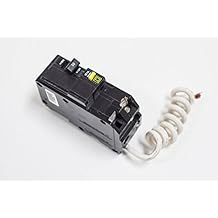
41BPl4rcNoL._AC_US218_.jpg
This is a SquareD QO Series 50A GFI Breaker. Coiled white is that neutral. 240 wiring used to be Hot-Hot-Neutral, three wire. Now it's Hot-Hot-Neutral-Ground.
 
Guys, I'm not an electrical engineer, nor do I play one on TV. However, from what I understand, AC current does cycle the electrons back via the neutral (which is actually connected to the earth, or "ground"), albiet not flowing, per se, but more like "wiggling" back and forth. So, one could measure the amount of current "coming back" on the neutral and verify that it's ALL coming back, and not leaking to the ground somewhere else. J-D, the picture you posted has that coiled white wire for just that purpose. That's how I understand the GFCI breaker works - if the current on THAT white wire doesn't match what's on the black wire, you have electrons "leaking out" somewehere else (perhaps a shorted out wire that leads to ground, like a metal boat lift), and the breaker trips.
 
That's true for 120v but 240v equipment only uses the two hot. Not the neutral... nothing is returned. Right now on my boat I m pulling about 45 amps but only 10amps is "returned" thru the neutral as roughly 35amp is used by 220v AC and pumps
 
Copy That, Captain. This "how it works" or maybe "why it works" is above my gopher-flunky pay-grade. I know from the RV world, that the shore tie pedestals for 50-amp (dual 50-amp breakers, essentially a 240-vac system) and 30-amp (single 120-vac) do not incorporate GFI. The 15/20-amp 120-vac outlets that look like the ones in a home kitchen, ARE GFI. And in most cases, will NOT supply an RV. They trip. Seems to happen with another above-pay-grade condition I hear of, called "floating ground."
 
Captain Pascal, I don't think electricity works that way. Amps are not "used up" as they flow through the circuit. The amperage on the circuit should show the same value no matter where on the circuit it's measured. Obviously If fewer electrons return back to the source than left it, there would be a serious problem with your component as it will be building up a charge of "used" electrons. Of course, there will be some voltage lost to heat over some distance, but not amps.

P.S. A standard home GFCI breaker will trip the breaker if as little as 5 milliamps are lost.
 
Back
Top