What if your fuel tanks had the same 10 yr old gas

bobalong

Active member
exMember
Joined
Oct 30, 2005
RO Number
19429
Messages
1,449
My buddy bought a Checkmate 35+' boat as a fixer upper. He has gutted the cockpit, removed the ailing 454 CI engines and exposed a center aluminum fuel tank. Encased in foam, and between the stringers. A company is coming tomorrow to pick up the approximate 100 gallons of skunk gasoline remaining from in 2001.
There is a coating on the sending unit and all surfaces that were in contact with the fuel for these last 12-13 years. He want to know if there is a way to dissolve this gas sludge after tanks are emptied without removing it. Aluminum tank.
This is a lifetime freshwater, trailered boat.
Believe it or not, the owner parked it in 2001 after a non fatal spark plug issue, did not winterize or cover it.
It was in a barn for a few years, sat at a used car lot a few years, and finally in sellers back yard until a few weeks ago.
It's in my buddys heated pole barn now, winter project.
Anyway. . . . sludge removal with tanks left in place ??
 
I'm not repeating my previous reply. Just the more important parts.

Feel the foam. If it's damp, it's likely the aluminum tank has corrosion. Either way, this is probably the only time this tank will have such easy access to inspect it.
 
I was given a 32 Plymouth with some 15 Yr old gas in the Tank.
It started right up on that old gas. As soon as I added new gas it ran just fine. I miss that ol' guy a lot too.
 
have the tank service inspect the tank while removing the fuel. probably a good idea to do a pressure test on the tank as well. it is a good idea to get a $ for a replacement tank before spending any $ apart from getting the fuel out.

if its 1k to replace the tank I would not invest 500 into testing & cleaning an old one.
 
Here are some tank cleaning services in Indiana:
http://www.thomasnet.com/indiana/tank-cleaning-82692377-1.html

Before your friend gets too involved with cleaning he might care to try a low pressure test for integrity. I believe that is usually just seeing if it will hold only a few PSI & he doesn't want to over-pressure the tank. And I'd imagine it would be wise to re-test after any steam pressure washing.
 
I had an F233 Formula years ago. I'm wondering if it's a stock tank. Mine was. 85 gallons that was foamed in place between the stringers. If it's a keeper, he's probably better off replacing.
 
My friend is pumping the fuel into 55 gallon drums provided by the company picking up the fuel.
This is do it yourself territory.
I'm pretty sure he will end up soaking the tank in parts washer solvent and as some suggested pressure it up 2-3 psi and see if it holds up.
A friend of ours is sewing some of the cockpit upholstery, his dad rearranging the rather slender stabbin' cabin. Friend of a friend brought a cherry picker truck over to remove the engines.
Engines have had a lot of go fast stuff installed by some previous owner who had more money than common sense. SS exhaust manifolds, chrome this and that, roller rockers, high end pistons just some of what I've seen.
And one cracked block.
The huge decals and gelcoat look almost flawless. He's into the boat for 5 grand with a custom trailer right now. Trailer alone is worth that. Guess he bought a trailer with a free boat on it.
Fix it up, mess around with it for a summer and flip it is what he'll do.
More than I would want to get involved with but that's just me.
Was just looking for do it yourself suggestions for cleaning the tank sludge. (for him)
 
quote:

Was just looking for do it yourself suggestions for cleaning the tank sludge. (for him)


I'm certainly no expert but, after buying a Wellcraft that sat for 4 years, here's what I did:
- Pumped out all the old gas (14 gallons).
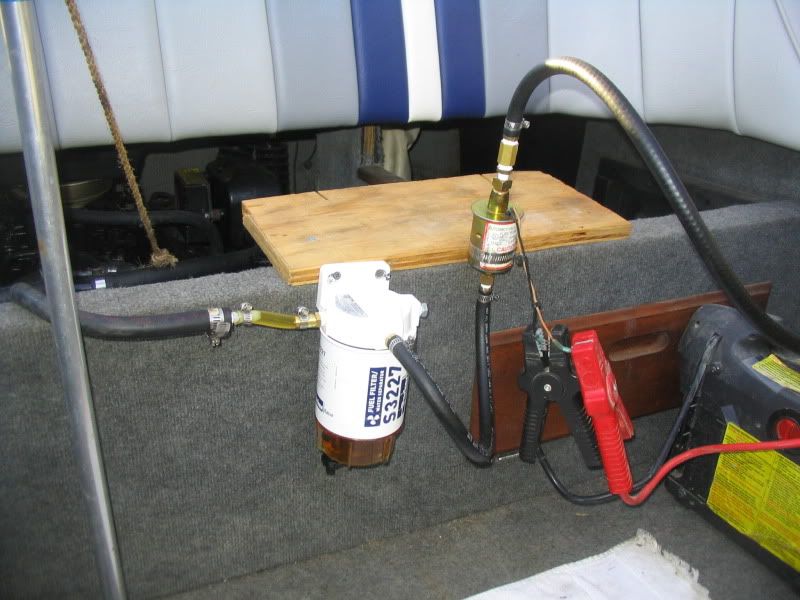
- (Temporarily) installed a Racor 10 mil filter/separator above the deck.
- Added 10 gallons of Sunoco E10. Remember, ethanol is a cleaning agent.
- Drove it around (on the trailer) for 20- 30 miles to slosh it around.
- Setup a circulation system to run it thru the filter for 4 weekends (see picture).
- Pumped out the 10 gallons (twice) and ran it thru my truck (no problems).

The end result was a good, clean tank. No problems since.

1111FuelPolishingsetup005.jpg
 
It really sounds odd that there's sludge in the tank. Is there any particular color to it or consistency or smell?

I just gave my 40 year old boat to a friend.It had 15 year old gas in full tanks. He put in new batteries and fired it up and took it fishing. Gas smelled fine.

So I was wondering what caused the sludge.
 
quote:

Originally posted by jtybt15

It really sounds odd that there's sludge in the tank. Is there any particular color to it or consistency or smell?

I just gave my 40 year old boat to a friend.It had 15 year old gas in full tanks. He put in new batteries and fired it up and took it fishing. Gas smelled fine.

So I was wondering what caused the sludge.


15 Yr old gas ?? And boaters on here worry about storing boat gas thru the winter . . . go figure.
He told me the gas smelled really bad, and I used the term sludge, probably not the correct description. I'll see the boat this weekend, get a better description.
 
Plus the chance that very old gas in a non-injected (non- ECM controlled w/ knock sensor) engine will cause damaging detonation is considered by most owners too high to risk . It may be wise to ask yourself whether it may be cheaper to remove all the fuel and replace with good/fresh, or very quite possibly have to rebuild/replace the engine .

Big ditto on Charlie's, "Smells bad, IS bad "(fuel).
 
Back
Top