454 Crusader T stat

cmariner32

Member
exMember
Joined
Jan 20, 2002
RO Number
7269
Messages
802
I have been battling a hot running engine for the last year and have been on the losing end. I talked with an old-timer mechanic who suggested swapping out the 160 degree t-stat with a 140. The engine is an '89 Gen 4 FWC big block crusader. It runs about 200 at cruise. I have replaced risers, raw water pump, all the hoses, backflushed oil, vee drive and main heat exchanger. Checked and cleaned raw water strainers. The mechanic said running at the 140 temp will actually aid in longevity of an old motor (1300+ hrs). Question: is the 140 T stat the same size as the 160 and has anyone else heard of putting a 140 into a FWC engine and what were the results? Thoughts and comments welcome.
 
I don't have Crusaders but isn't there a u-shaped cooler on that engine. I've read on here that it can be suspect in over heating issues.
Al
 
A 140 degree stat will fit. Don't know what the results will be. My 454 Crusaders used to have 140 degree stats when they were RWC. They ran at 150 degrees but there were no heat exchangers.. Al is correct, have you checked your oil coolers?
 
as I understand it, cooler thermostats are used in raw water engines to reduce issues with salt water in the steel engine block.

During my 454 gasser years I ran 180 degree thermostats in mine, and that was in Florida.

The hotter engine increases efficiencies, and they always ran at 180-190.

Never ever overheated. not once.

There is a test kit that will detect carbon monoxide in the radiator tank, available from NAPA.

This will allow you to confirm or rule out a head gasket issue.

If I recall, the u shaped cooler is the transmission oil cooler?

RWS
 
The U shaped cooler is mounted just behind the alternator on the bottom of the engine, I broke a rib and separated a collar bone getting to mine. It has a hose going to the remote engine oil filter and one to the engine oil filter mount. It may as well do the transmission as there are 2 other small lines that hook to it that I did not trace out yet.........D...........
 
I do have a U cooler which cools both the engine oil and transmission fluid. When I hit both of them with my IR gun, the temp differential is less than 10 degrees. The 200 degree temps only occur when cruising at 3000+ RPM's. When I ran my problem past this "old salt" mechanic, he suggested dropping the T stat to the 140's saying I may lose some efficiency, but the lower operating temps will greatly prolong the life of the engine. I do have low compression on a couple of cylinders on this engine 120-130 lbs. on 3 cylinders. I have deferred doing a wet compression test to see if it is the valves or the rings-a definite project this fall when the temps cool, and the boating season slows. I was just hoping someone else on here has run a lower temp T stat on a FWC engine and what their results were. With 25 yr. old engines with 1300+ hrs, if I can squeak out 3-5 more years before replacement, with a simple T stat change....I will do that in a heartbeat. I just don't know if the 140 and 160 T stat have the same footprint.
 
As I posted above, go to that thread. I have done what your considering, and the result was no change. The 142 and 160 have the same foot print as long as you buy the right one of course. You wont find the 142 at an auto parts store, I could only find them from a marine supply. My engine only has 170 hours on it........D..........
 
In my eyes, of the list of things to battle with a hot running engine, changing the temp of a thermostat is not on it. It sounds like you have tried to go through all the components of your raw water circuit, that's very good. I'm a big fan of overhauling all the components in a system.

Two things I have not heard in this thread.

1.). What about the circulating pump? Engines with a heat exchanger have both a raw water pump as well as a circulating pump.

2.). Have the timing and advance checked. An engine that is running out of time, may run fine but generate more heat than the cooling system wants to deal with.
 
Great input!! Thanks. I have yet to check the timing on the engines since I bought it 3 years ago-that is a definite step to take. I never had a hot run situation until this year when both engines started to run hot. The port engine turned out to be the raw water pump. I thought the starboard engine problem was a lot of crap in the strainer, I had the raw water pump rebuilt by Depco last year. After cleaning the strainer and backflushing the oil cooler and V drives, I still have the problem. With the circulating pump, forgive my ignorance, but other than leaking at the seal, what goes wrong with a metal centrifigul impellor to cause loss of flow at higher RPM's?
 
Have you checked your raw water strainers?

RWS
 
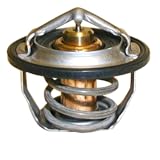
Part way down, cm32 mentioned "Footprint." I don't think I can find it anymore, but George had a page dedicated to Thermostats. He showed where many might "fit" but some have extra features that control just not WHEN the water flows but WHERE. For example, when it opens one passage it might close another.
For example, our MerC uses one that looks like this

51BR63C23GL._SP160,160,0,T_.jpg


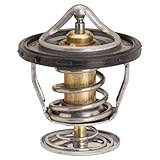
Another sample (Amazon lookup "chevrolet thermostat") looks like this

51aeAPaDjtL._AA160_.jpg


That extra piece there on the bottom is meant to do SOMETHING.
 
quote:

Originally posted by cmariner32

When I hit both of them with my IR gun, the temp differential is less than 10 degrees.


Whenever I hear of somebody using an IR gun, I assume until proven otherwise that they don't know how to use one properly with regard to distance and cone of averaged temps. Nothing personal of course. :)
 
quote:

Originally posted by cmariner32

Great input!! Thanks. I have yet to check the timing on the engines since I bought it 3 years ago-that is a definite step to take. I never had a hot run situation until this year when both engines started to run hot. The port engine turned out to be the raw water pump. I thought the starboard engine problem was a lot of crap in the strainer, I had the raw water pump rebuilt by Depco last year. After cleaning the strainer and backflushing the oil cooler and V drives, I still have the problem. With the circulating pump, forgive my ignorance, but other than leaking at the seal, what goes wrong with a metal centrifigul impellor to cause loss of flow at higher RPM's?


Circulating pumps are not as prevalent failure wise than a raw water pump of course. Typically a marine pump lasts quite a while, bearings still being the most likely issue and you would likely hear them. But....then again, I just paid a guy to replace the rear main seal of a small block chevy and everyone says those never leak. You could be the lucky dog. Not likely, but given where you are at, its a simple component with a critical job, however rare a failure. Open the exchanger cap and see if you can see active circulation. If not, suspect it.

There are two sides to your cooling system and they both have to work, I'd try to get a visual on whether your raw water coolant is exiting at the same volume on both engines. That should at least tell you whether you have a restriction somewhere. At your stage, time to get paranoid and start wondering about internally collapsing hoses, actually looking down the rods of your heat exchanger(s) (I know the transmission you can't), and also looking for missing pieces of an old impeller now lodged somewhere creative.

Just remember, it IS a simple system. If you go through it piece by piece and prove each to be in full functioning form, you will find it.

I did have two new thermostats go bad in a row not too long ago. Rare, but can happen. Mine was easy to diagnose as the engine ran too cool, there is only one cause of that! These kinds of things are not likely, but you may be the lucky dog. Finally I got a Stant and no more problems. That said, whenever I hear of a mechanic recommend thermostat changes as a means to solve overheating issues, on an engine that was designed and ran on one for decades. Well, lets just say that's a hot button.

Oh...and troubleshooting wise you have to ask yourself "what changed", since this is a new problem. Timing wise, unless that distributor is loose, the distributor timing did not change. Now if you have an advance on that....that's possible.
 
quote:

Originally posted by j-d

Part way down, cm32 mentioned "Footprint." I don't think I can find it anymore, but George had a page dedicated to Thermostats. He showed where many might "fit" but some have extra features that control just not WHEN the water flows but WHERE. For example, when it opens one passage it might close another.
For example, our MerC uses one that looks like this

51BR63C23GL._SP160,160,0,T_.jpg


Another sample (Amazon lookup "chevrolet thermostat") looks like this

51aeAPaDjtL._AA160_.jpg


That extra piece there on the bottom is meant to do SOMETHING.


Good point . "Something" is open/close the bypass circuit. Easy to get the wrong generic t-stat for any specific temp. .

http://www.boatered.com/forum/topic.asp?TOPIC_ID=51165
 
This is the part number of the one you need if you want to go the 142 degree route. Sierra 142 Degree Thermostat 18-3551..........D..........
 
Gawd I wish GVP was still around. Good points about changing the T stat temp rating to accomodate a running hot issue. My other engine runs perfect at 160 at cruise since I replaced the raw water pump and cleaned the raw water strainer. I felt sure the issue with the remaining engine was the dirty raw water strainer and was flumoxed when cleaning it did not improve the running temp. D, the part number you provided matches up with the part number I was able to track down. NAPA can cross reference with the automotive equivalent, but then again....I'm starting to lean more towards finding the real culprit. The mechanic that told me to run lower temp t stats suggested that lowering the temp would extend the life of the engines-kinda made sense to me and was wondering if anyone else had heard of or knew that to be valid. At low RPM.s the exhaust shows a negligable difference in water flow. At 3000 RPM, the flow seems to be slightly less than the cooler running engine, but I cannot be sure. In regards to my abilities with an IR gun, I profess not to be an expert, only that I aim the laser point at the same spots on both engines at the same distance and note the temps. It is only a cheap Harbor Freight gun, but seems to be fairly accurate-a difference of a couple of degrees in my mind is negligable and not considered in my search for the source of the problem.
 
Have you checked the RW pickup scoop strainers? They often get heavily painted with the hull and if the slots or holes are not cleaned out before splash they can certainly prevent sufficient flow for cruise speeds as has happened to me. I always make sure I carefully rake those slots on mine before the yard splashes the boat in Spring as the yard does not always do as they promise. I check them every time I go under to scrub the bottom and replace the 6 anodes too during the season.

And if the bottom paint doesn't adhere well enough, barnacles and weed can also inhibit higher flow. Fouling can also occur inside the scoop or thru hull , which is why a year and 1/2 ago I switched the 3 scoops to Groco's ASC series RW pickups with cleanout hatches. Very handy to not only clean out in there but also to access and paint in there to prevent fouling.

It can be important to replace the sea strainer lid o-ring also to keep air from being sucked in from an elongated and squished o-ring. On some Groco screw lids for example, the o-ring can be distorted if the lid is tightened a little more than hand tight .
 
On the IR gun, the red dot is just a pointer, it will essentially average a circle around that point. The size of the circle is based on the distance you are away, it can be pretty large. If you are a few feet back, you may not be effectively measuring two different points. Best to get within a few inches of the points your are trying to measure. The gun will tell you the size of the cone are various distances.

Looking back, you do note you changed the hoses, so we can put aside collapsing hoses. Circulation pump is still possible, but given you think you can see a reduced flow, a restriction is still the most likely scenario.

1.) Everything Sandy said, this is a very possible source of restriction.
2.) Looking at your prior notes I have to ask, have you physically removed the main heat exchanger end cap and viewed down the tube bundle? Especially the inlet side. If not, that's priority #1. Back flushing will do almost nothing to these things. If the tube bundle is largely blocked, I've often had to boiled them out with acid until I could get a rod through them. A rifle cleaning brush of caliber to match the tube works well.

3.) There could still be a restriction in the oil cooler, I understand you can't look into this one. Assume its bad until proven otherwise. You already went through the risers, so I trust we can eliminate those.

The raw water system is really very simple, you are either not producing flow which would be your raw water pump, I'm sure you could dream up a test to prove it really is gushing out water, messy as that would be. If not the flow, then you have a restriction. You simply have to find it. It would be a really rare day to find good flow and low restriction and not have heat transfer.

As a hail marry you "could" try a little ridlime to dissolve concretions and old zincs. This approach is not my favorite, but short of replacing oil coolers out of the principle of time, it may be your only solution for the parts you can not open up and inspect. It will NOT help you with an impeller that came apart and the pieces are still blocking your heat exchanger. That's actually a pretty likely scenario, again until proven otherwise.

If you do those few things, there really would be very little left to be causing issues.

Still don't like your mechanic.
 
Sandy and Ghost...I really appreciate your input. I have my bottom cleaned monthly so I am assuming the intake strainers are not the problem. I have replaced the intake strainer gaskets and I feel quite confident the strainers are not the problem. I have Buck Algonquin pancake style strainers which I have decided have a marginal fouling factor and require purging air in the system to provide proper water flow-a 6 inch screen is not sufficient for providing enough of a fouling factor for big block engines water requirements. Even considering the marginal strainers which are now clean, the water flow at high RPM's is suspect. Ghost, I have not pulled the HE end cap to check, but the circulation route is thru hull to Walter Vee drive to raw water pump to U cooler to FWC heat exchanger. The heat exchanger would be the least likely suspect for crap to get thru the Vee drive and U cooler heat exchanger, but then again....shouldn't be ruled out. I have already spent way too much money and time trying to figure out this problem. I was hoping running this past the enormous knowledge base would provide me with a something that I have overlooked. Thank you all for your input. I have some new things to look into before I break down and call in a $90/hr mechanic to solve my problem. And yes ghost...I have prety much dismissed this mechanic from further consultation. Now if I could find a suitable replacment.............
 
Back
Top