Anyone with big block knowledge?

my mpi incarnation of this motor had all kinds of external coolers - it ran seawater through a fuel cooler, power steering cooler, and oil cooler ( at least I think there was an oil cooler?). Do i really need all of this? it takes up a ton of room, all of the 23 year old parts look like crap, and will be a fortune to replace, and just more things that can leak and eventually fail.

If I’m flushing sea water through the motor ( that’s generally under 70 degrees until last few trips of the season). I’m thinking that should be enough for the oil. My car doesn’t cool the PS fluid, does my 23’ bow rider really need it? And the fuel? Perhaps it is needed for mpi, but now that I’m running a carb at about 6 psi, do I need to care that much about the fuel temp? Hoping for as few wires and hoses as possible, on a very simple setup.
 
While the car does not have those things, I believe the idea is to keep the bilge from getting as hot as what is under the hood of a car. Consider that the bilge blower is not on all of the time, yet the car has (in comparison) quite a bit of air moving through it. Yes, the car Tstat is probably 30 degrees warmer than the boat's tstat but without the coolers the associated accessories will merely keep building heat. Then there is the fact that a boat engine is turning quite a bit more rpm than a car engine at cruise. I don't know what the forces associated with swinging an outdrive are but once moving the car's might be less. Variable assist and electric power steering are being installed in cars is that happening in boats now?
Why not just hit them with a sander, some rust converter, and a fresh coat of paint?
If boats got the same mileage as cars, I'd think the heat generated would be less but over a given amount of time I think it is safe to say a boat is burning more fuel, spinning things faster, while working harder therefor it needs coolers etc.
 
  • Like
Reactions: alk
Alk, I have 2 Holley 850 cfm carbs you’re looking for. They just happen to be sitting on top of 2 454 CrusaderXLs and inside my 94 34C that’s for sale! It’s a package deal.😁
 
when you decide you are ready to part her out, give me a ring! :)

i can’t catch a break with this carb search. ive found several carbs locally for under $200, but always too small, or wrong bore. A new one that meets my needs is $800-$1000, which is more than I want to dump into this motor.
 
I sold my used gummed up Holley 750 for $250 on ebay, I was shocked! The replacement 600cfm Edlebrock was $450 (air cleaner extra).

I'm waiting to hear responses to all of the oil coolers. If I were you, I'd be tempted to remove the fuel and power steering coolers. Less tempted to remove the oil cooler....unless you install an oil temp guage.
 
what size motor are you running the 600 cfm on, a 350? I'm probably going to run this motor initially with the 650 spread bore, and an upside-down adapter plate, just to get the motor running and back in the boat. Should be able to tell if it's choking for more air, and if so, will increase carb size at that point.

part of the problem with the coolers is that the areas around the coolers seem to be subject to a lot of corrosion. I don't think they are leaking, maybe they are though. Or perhaps just prime spots for condensation which drips off, but merc plumbed them in places I would rather not have corrosion. Especially where they put the steering cooler. When I start boating in May, the water temp is in the low sixties. Doesn't break 80 until last couple days of the season. And I plugged off the little straw that runs through the drive for raw water pickup and replaced with a transom scoop. So I get a lot of cool water through this motor - which eases any of my concerns on oil temp. The steering cooler is the one I'm most inclined to leave. Of course it's the one I most want to get rid of!
 
The engine in my 1987 Monte Carlo is a Chevy 350 small block ZZ3 crate engine. When I picked it up, it had been sitting for a while with a blown automatic transmission so I installed a clutch and switched to a World Class T5. The carb was dumping fuel into the engine, the exhaust smoked like a bandit and would bog down at idle. Since I am not bringing this to the track, I switched carbs and now it runs like a dream. But its not a boat, it has a 5 speed....plus I don't have any reference to a good running 750cfm carb.

I'm guessing you'd be ok removing all of your coolers, they are probably standard for boats in Florida and even warmer climates. My previous boat was a volvo and had none of this extra cooling nonsense.
 
  • Like
Reactions: alk
It runs! Kept the steering cooler, deleted the fuel and oil coolers. Might add the oil one back in, but will have to order some new hoses first.

strange, I can see the video on my phone, but only hear the sound on my PC.
 

Attachments

Last edited:
Just about every I/O with power steering I have seen has a PS cooler, but I've never seen a fuel cooler on an inboard with a carb.
The oil cooler for the engine oil I'd probably want, but if you don't add it back I would use a 25/40 or 25/50 marine oil, or a straight weight 40. While I/Os and inboards run cool water temps compared to auto applications of the same engine, the engine oil temps can be quite a bit higher and the high rpm use combined with high oil temps shears down auto based motor oils. If you download the vid you can see it, kinda grainy but you can see it. Looks & sounds good.
 
  • Like
Reactions: alk
It’s been a while since I updated this thread - but was able to get the motor running nicely with the carb and old school ignition. Been out for half dozen rides this summer - runs great, no temp issues. But I seem to be having a charging problem.

the alternator sometime kicks nice voltage back, sometimes it does nothing. Which has me wondering if the voltage regulation was previously managed by the ECM, and now that I’ve torn all the stuff out, I’m flying blind. It’s a four wire alternator, if you count the negative post. I thought I had it wired correctly, but it was months ago, so not sure anymore. Maybe I’ll just replace it with whatever alternator merc lists for the carb version of this motor?
 
Call ARCO tech support they actually answer the phone and are helpful.
 
Continuity of the wires is shakey? Check all of the connections as well as the junctions between the wires and connectors. Could be a bad regulator or diode in the alternator.
 
all of the connections are clean and solid. And I believe I wired it correctly. But having a hard time getting info on whether or not the 'dinosaur' MEFI ECM on these L29 motors regulated the voltage, or if there is an internal regulator. If I had to bet, I would say that the ECM was taking care of the regulation.

My parts guy let me borrow a mando alternator with a built-in regulator that he had in his shop. Will give that a try this weekend. All of the online info seems to suggest that on the excitor terminal for a 3 wire GM setup, you should have an indicator bulb, or some other type of resistance between the ignition on, and the exciter terminal - else the excitor will back feed the ignition and continue to deliver spark after shutting the key off. I clearly don't have that.

the balmar's are in the $1,000 range. Which I guess would be appropriate if I had an actual electrical load - but on this boat I don't even have a stereo, or single instrument - starter, spark, nav lights, trim motor, fuel pump, choke, bilge pump and VHF make up my electrical.
 
installing a intake and 1410 eldebrock carb is an awesome upgrade have done a few and every one runs better
 
I never did figure out why alternator puts out nothing at idle speed, until I let it rip for a while, then is in the 13-14 volt range even when slowing back to idle. I think I even put a new alternator on, in 2023, and it behaved the same. But I ran it last two summers like this, without any issues. Carry a charged jumper pack with me all the time now!
 
I never did figure out why alternator puts out nothing at idle speed, until I let it rip for a while, then is in the 13-14 volt range even when slowing back to idle. I think I even put a new alternator on, in 2023, and it behaved the same. But I ran it last two summers like this, without any issues. Carry a charged jumper pack with me all the time now!
Something must not be wired correctly if the regulator does not adjust the voltage at idle. A four terminal alternator would seem to imply external regulation. How did the mando behave? BTW is it a MARINE alternator? It had better be.
 
Yes, marine alternator. It’s been a couple of years, so my memory isn’t fresh, but I think I was having trouble finding an appropriately wired alternator with serpentine belt, they were all made for computerized installs. then I thought my voltage gauge was bad. Then I finally just gave up and went boating.
 
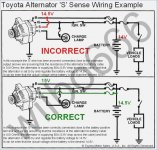
Some alternators have an S for 'sense' (voltage sensing) terminal, and with these, you can run a wire from that terminal, to where you want the voltage measured for feedback to the voltage regulator. Ideally, the battery, or the common terminal on the battery switch. Some people just run a jumper from the S terminal to the B+ terminal on the alternator (alternator output) which also connects to the starter solenoid and that connects to the battery switch common terminal. ARCO's website has some tech information on how to wire up alternators.
Here's an example of how to set up a proper sense circuit...and explains why it's better for the sense wire to go to the battery or as close to it as possible vs connecting it to the B+ terminal.....
Sense circuit wiring.jpg
 
Back
Top