
You are using an out of date browser. It may not display this or other websites correctly.
You should upgrade or use an alternative browser.
You should upgrade or use an alternative browser.
Diesel versus Gas
- Thread starter bambrose
- Start date

- Joined
- Sep 16, 2003
- RO Number
- 12212
- Messages
- 12,185
1000 hours for a high hp / small engine... 10 000+ for a slow turning, low HP engine...
diesel vapors can't explode... unlike gas. i wouldn't say that diesel isn't as dangerous, I'd say diesel is safer.... gas engines are not dangerous unless not maintained...
they're not necessarily harder to maintain, after all they dont' have ignition system. they're different and again it depends on the engine. However they are more expensive to rebuild... while you can get a short block V8 for a under $5000, rebuilding an 8 cylinder diesel will usually cost you $20k+
diesel vapors can't explode... unlike gas. i wouldn't say that diesel isn't as dangerous, I'd say diesel is safer.... gas engines are not dangerous unless not maintained...
they're not necessarily harder to maintain, after all they dont' have ignition system. they're different and again it depends on the engine. However they are more expensive to rebuild... while you can get a short block V8 for a under $5000, rebuilding an 8 cylinder diesel will usually cost you $20k+

- Joined
- Jun 8, 2004
- RO Number
- 13885
- Messages
- 2,976
What Rommer said
I find at the end of the year the cost to maintain may be more than big blocks because I have someone else do the maintenance and your using gallons of oil instead of quarts- but I don’t think I will ever go back to Gas for my primary boat
I find at the end of the year the cost to maintain may be more than big blocks because I have someone else do the maintenance and your using gallons of oil instead of quarts- but I don’t think I will ever go back to Gas for my primary boat

- Joined
- Mar 23, 2004
- RO Number
- 13060
- Messages
- 2,554
I agree with Rommer, Pascal and abalmuth.
I would also add that parts and mechanics are expensive. So while scheduled maintenance intervals may be longer, they will cost more than your annual gas maintenance. Some think that you can ignore those big maintenance items and just do annual oil changes i.e. "if it runs fine it is fine". That adds up to trouble later on.
I too would not go back to gas for anything bigger than 32.
my .02
I would also add that parts and mechanics are expensive. So while scheduled maintenance intervals may be longer, they will cost more than your annual gas maintenance. Some think that you can ignore those big maintenance items and just do annual oil changes i.e. "if it runs fine it is fine". That adds up to trouble later on.
I too would not go back to gas for anything bigger than 32.
my .02
I hate to recycle Jim's posts, when there are SO many classics that have to be revived... Still, this seems like a good time to remind Jim that maybe he shouldn't tell people not to ask questions. Just a few months ago, Jim learned who manufactured HIS OWN BOAT. Yes, Jim owns a classic Trojan, but thought that Carver built it (as they did the much, much, much later and completely unrelated models).
Jim, please sell your boat.
Jim, please sell your boat.

Rough estimates for diesel rebuilds are often given "per hole", but the actual displacement/size of the engine isn't as relevent. My neighbors rebuilt one of their Detroits BY THEMSELVES. They made a cradle, and jacked the engine up into the salon, re-sleeved it, put on new turbos and cranked her back down. Total cost of parts was less than $6,000. Non-sleeved engines, even if the block can be saved, typically aren't the kind of thing a do-it-youselfer will (or should) tackle.
Sophisticated electronic controls can throw an expensive wrench into the game as well. I've known several boats that have been disabled by electronics, but the mechanics wasted time and money by looking for mechanical explanations. That's a fast way to drive up maintenance costs.
Sophisticated electronic controls can throw an expensive wrench into the game as well. I've known several boats that have been disabled by electronics, but the mechanics wasted time and money by looking for mechanical explanations. That's a fast way to drive up maintenance costs.
bambrose, When it comes to diesel versus gas. I always ask my clients what type of boating they do and where. If your running in open waters most of the time and have a larger vessel, diesels are the way to go. If your inland and have a vessel 35' or under gas engines will do the job. Keep in mind diesels burn less fuel and last longer, but when you weigh and measure the expense its all about application.
- Joined
- Aug 1, 2002
- RO Number
- 9587
- Messages
- 1,035
Bambrose, that's a pretty good question which you have received very good replies...well mostly.
No question is a dumb question. Besides, how will one ever know, if one never asks?
No question is a dumb question. Besides, how will one ever know, if one never asks?
to me diesels are easier. give them good clean fuel, fresh oil and do not over work them (via over propping) and you should get some very healthy service life out of them.
bottom line is when do they start saving you money or when will they cost you money. run them 30hrs per year... they will rot out before you get full life from them, run them 250+ hours a year, maintain them, they will probably out last you and the next owner
bottom line is when do they start saving you money or when will they cost you money. run them 30hrs per year... they will rot out before you get full life from them, run them 250+ hours a year, maintain them, they will probably out last you and the next owner
All I will say as a boat owner is that buying a boat is the worst economic decision you can make.
You can minimize buying a used boat, etc....but it really comes down to what you want. I wanted a big inboard diesel in a 27ft Chesapeake Deadrise Workboat.
Make sense? No, do I love the boat? Yes.
You can minimize buying a used boat, etc....but it really comes down to what you want. I wanted a big inboard diesel in a 27ft Chesapeake Deadrise Workboat.
Make sense? No, do I love the boat? Yes.
In all of the boats I have looked at I have never seen a marine engine worn out. The owners kill them. Manifolds and risers 15+ years old and they wonder why they lost two pistons on the same side. Maintain either gas or diesel and they will last a long time. Gas fumes are explosive while diesel is not. Maintain the gas system and it is safe. Think about this... if gas was unsafe would anyone produce a boat using it. Me thinks not. the manufacturer would be out of business very quickly, one lawyer and it would be bankrupt. As for life expectancy as others have said, the hp/weight is the deal killer. More HP less weight and life expectancy is going down. Last month I surveyed a boat with twin 454's it had 1200 hours indicated. The owner was proud of the fact he runs them at 5200 RPM all day long. So it does have something to do with maintenance and the service it was put in. As I said owners kill them. .. Fred
Agree with much that is reported here. The only thing I will add is how diesels are serviced in Michigan. It is not uncommon to see a diesel mechainic (for example a Cummins rep) from Grand Rapids servicing engines in northern Michigan 250 miles from his home base. In addition to spending 2 days on a boat doing the 500 hour service, you are paying milage and housing plus parts and labor. That is a big bill at the end of the service appointment. By contrast, you can have 8.1s serviced in just a few hours and the tech will come from a local marina. Obviously this is much cheaper. Most of the diesel customers enjoy dockside service but they pay more for the convenience. Having said all of this, you really don't have much choice in the matter once you decide the diesel is necessary for your given boat.
I'm 43'loa, 24,000lbs fueled and loaded; and running twin 380hp Merc gasoline inboards with zf hurth v-drives.
Purchased my boat 7 years old.
The diesel version of my that was available for sale was $71,000 more than the gas version. Same make, model, year and basically same options.
That $71,000 equated to a 50% price difference.
I couldn't justify the extra expense.
Would I prefer diesel? I guess...sure.
I can buy a full repower and a whole lot more for $71,000...
Or a huge amount of fuel at the reduced efficiency.
Gas explodes - diesel doesn't - so diesel is safer.
Not a lot of boats explode though.
I understand a 454, and could tear it down if I needed to.
Diesel has so many advantages - but I personally think the tipping point is the point where a gas motor isn't going to produce enough torque to efficiently get the boat going and up over it's bow wake...unless you really know diesel and can avoid hiring everything done.
With the twin 380hp gas, I cruise at 23knots at 3750rpm.
Pretty normal cruise for gas engines...and I burn 30gph.
Purchased my boat 7 years old.
The diesel version of my that was available for sale was $71,000 more than the gas version. Same make, model, year and basically same options.
That $71,000 equated to a 50% price difference.
I couldn't justify the extra expense.
Would I prefer diesel? I guess...sure.
I can buy a full repower and a whole lot more for $71,000...
Or a huge amount of fuel at the reduced efficiency.
Gas explodes - diesel doesn't - so diesel is safer.
Not a lot of boats explode though.
I understand a 454, and could tear it down if I needed to.
Diesel has so many advantages - but I personally think the tipping point is the point where a gas motor isn't going to produce enough torque to efficiently get the boat going and up over it's bow wake...unless you really know diesel and can avoid hiring everything done.
With the twin 380hp gas, I cruise at 23knots at 3750rpm.
Pretty normal cruise for gas engines...and I burn 30gph.
Jeff, I have to agree with your general premise. But a couple of other things to consider.
The first is whether the boater will be satisfied with the performance in his particular boat. Of course, it may, as you argue, cost just too much to get that.
Second, gas engines pushing a heavy boat just will not last long - especially if they are propped incorrectly for that application.
And finally, I have some problem with your numbers, so let me question them a little. You have a Cruisers 3870, which you say is 43'loa. It probably is, but that's an issue with current measuring conventions. That 3 ft pulpit is irrelevant to our discussion. I would be curious the dry weight published for this boat - although I agree with your decision to state a fully loaded weight. Still, it's hard for gas engines to get a boat that heavy moving at 23 kts. And, to burn only 15 gph out of 454s up to 3750 while loaded enough to move that boat along sounds low. The max fuel burn for those engines is much higher, and 3750 is getting there. So I don't see how you can do it that efficiently. None of this argues against your basic premise, but it sounds just a little too rosy.
The first is whether the boater will be satisfied with the performance in his particular boat. Of course, it may, as you argue, cost just too much to get that.
Second, gas engines pushing a heavy boat just will not last long - especially if they are propped incorrectly for that application.
And finally, I have some problem with your numbers, so let me question them a little. You have a Cruisers 3870, which you say is 43'loa. It probably is, but that's an issue with current measuring conventions. That 3 ft pulpit is irrelevant to our discussion. I would be curious the dry weight published for this boat - although I agree with your decision to state a fully loaded weight. Still, it's hard for gas engines to get a boat that heavy moving at 23 kts. And, to burn only 15 gph out of 454s up to 3750 while loaded enough to move that boat along sounds low. The max fuel burn for those engines is much higher, and 3750 is getting there. So I don't see how you can do it that efficiently. None of this argues against your basic premise, but it sounds just a little too rosy.

- Joined
- Feb 1, 2007
- RO Number
- 25075
- Messages
- 1,698
Here's the actual performance chart from my 33' Trojan International with twin carbureted 454's before the conversion to diesel.
Her published weight was 12,500, but with the genny, wetbar, two fridges, other options & fuel, etc she is 17,000 fully loaded.
Here's the chart
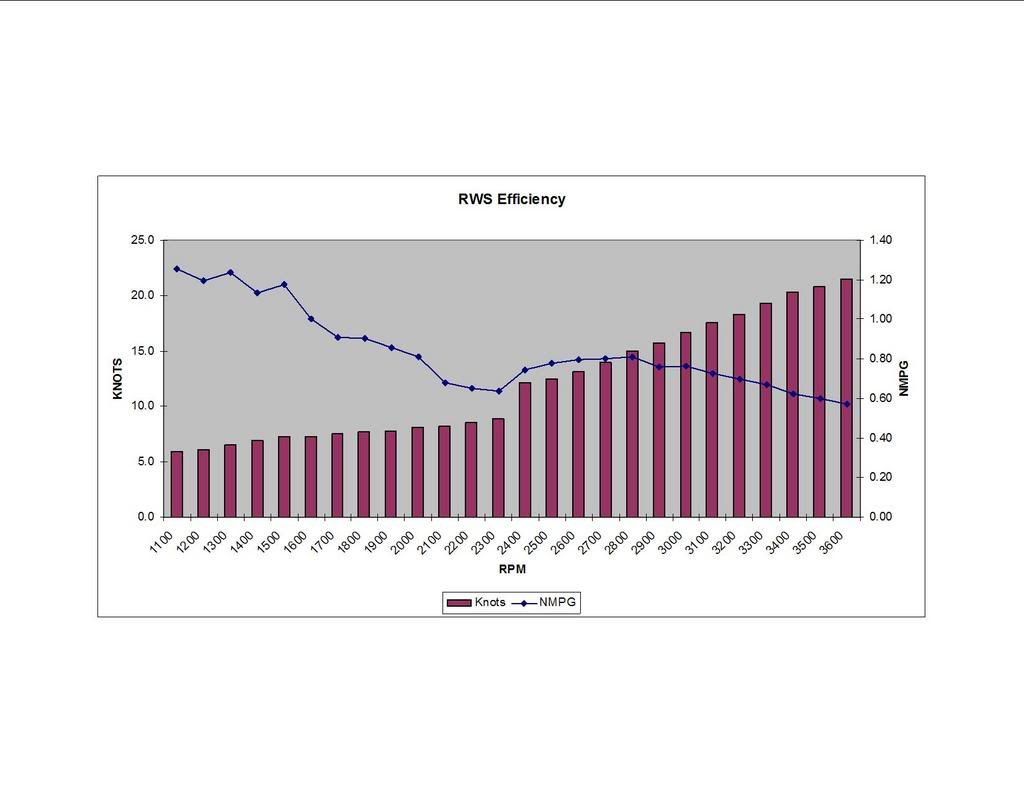
Her published weight was 12,500, but with the genny, wetbar, two fridges, other options & fuel, etc she is 17,000 fully loaded.
Here's the chart

- Joined
- Apr 14, 2006
- RO Number
- 20854
- Messages
- 1,192
The main thing that concern me about diesels is the rebuilding costs, as Pascal put it. That, and cost of maintenance, maybe in FL it's no problem with so many diesel boats, but in many inland waters you'll pay a big premium.
Now, I agree gas requires more constant monitoring to minimize risk of explosion, on the other hand I've seen many reports of diesel fires, in many cases people assuming that it's a gas boat that's burning when it indeed is a diesel boat. So, you always need to properly maintain your stuff. For me, the main reasons why I would want diesel is actually the CO when running genset on the hook, and the additional torque at low speeds around the docks.
Now, I agree gas requires more constant monitoring to minimize risk of explosion, on the other hand I've seen many reports of diesel fires, in many cases people assuming that it's a gas boat that's burning when it indeed is a diesel boat. So, you always need to properly maintain your stuff. For me, the main reasons why I would want diesel is actually the CO when running genset on the hook, and the additional torque at low speeds around the docks.