
You are using an out of date browser. It may not display this or other websites correctly.
You should upgrade or use an alternative browser.
You should upgrade or use an alternative browser.
Floscan installation
- Thread starter PJ
- Start date
Greg, the red button is the totalizer reset. Now I have grandchildren and a red button is just waiting to be pushed. I did want to put it out of the way on the side of the instrument panel.
Now when I talked Flowscan they recommended the shielded cable for gas installs.
I have had no interference with the compass.
Now when I talked Flowscan they recommended the shielded cable for gas installs.
I have had no interference with the compass.
Since you guys are sharing thoughts about FloScan installations here are photos of the 5500 I installed on our Carver several years ago. Like PJ, I set it up to read twin inboards via the black switch to select which engine I wanted to monitor "real-time". The red button is actually a "Kill Button" that was designed to use a lanyard (I got it from BoatFix). I discarded the lanyard and intentionally wired it backwards so you needed to pull the button out and hold it to reset the Totalizer rather use a regular button that you would push in. This was doen to eliminate any possibility of unintentional resets.
Thanks to having a machine shop available at one of our plants I was able to have the mount custom made. It was hogged-out of a hunk of stainless steel. That mount was probably worth more than the gauge!!
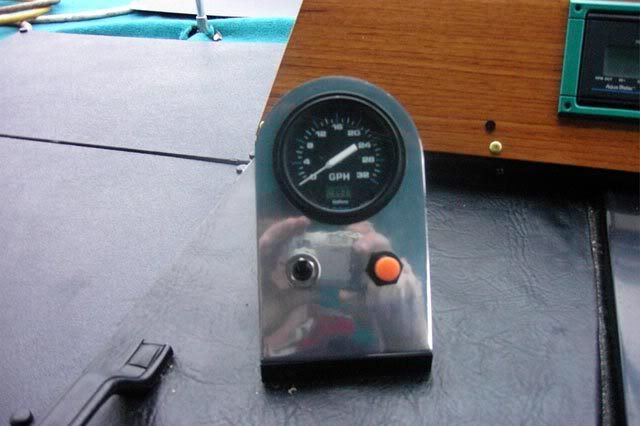

Thanks to having a machine shop available at one of our plants I was able to have the mount custom made. It was hogged-out of a hunk of stainless steel. That mount was probably worth more than the gauge!!
I bit the bullet (or more appropriately, dug deep in my wallet) and installed a FloScan system on my boat. I just finished it last week with the help of an engine-savvy boating friend of mine.
Sorry for the blurry photos as I have only had the boat out once. But man-oh-man, what a difference a few RPMs and trim angle makes on the fuel mileage. This boat is ultra sensitive to changes in speed and angle, fuel mileage wise.
I got from about 0.8MPG to about 1.3MPG, with speeds from 22MPH to 7MPH, and in different sea conditions; flat, and 3ft head seas.
I need to do some more runs, but my initial impression is that I am rather pleased. Good thing too, since this was not a cheap installation.
One issue with my engines, 1995 Crusader EFI is that they have both supply and return fuel lines; similar to diesel engines. This limits the fuel flow setup that can be used as most systems designed for gas engines only has a single sensor.
I wanted to have a solid installation, so I used 3/4" starboard to make mounting bases. One thing I wish I did though is to install connectors on the sensors. The supply lines have FloScan-recommended Flow Eazy 238 micron filters. Hopfully being 238 micron, they won't need to be cleaned anytime soon. FloScan sez their sensors can pass anything smaller than 238 micron.
One thing I did find is the internal dimension of the barbs and adapters is quite a bit different. I purchased some barbs from an auto performance house but the internal dimension (ID) of the items were a bit small. I ended up purchasing barbs and adapters from Moeller Marine, which had larger a ID, and the barbs were longer so that it was easier to get two hose clamps on each barb.

One other item was that I had some concern on the ID of the fuel line in the boat. The Carver documentation indicated 3/8" ID, which is a common size. However, I also bought some new fuel line (USCG A-1) and the OD of the new hose was significantly smaller than the lines on the boat. This lead me to believe that the hoses on the boat might be more than 3/8" ID, and I surely didn't want to go cutting into the fuel lines without having the right sized barbs.
I called the manufacturer of the hose on the boat (Trident), and they were surprised that there was no part number marked on the hose. But they did say that their older hose - 1995 era - had thicker walls, so even though the hose in the boat was bigger than the stuff I bought, it was likely 3/8" ID as well.
It took a bit of faith on my part, but when we cut into the hose, sure enough, it was 3/8" ID.
I mounted the NMEA2000 interface boxes in the rear hanging closet in the boat. It was the only location I could think of that was outside of the engine room, but close enough to the engine room so that the sensor wiring would not be excessively long.
One problem I did have is that when I started the engines, the NMEA interfaces would not work. But after power-cycling them once, everything started working.

The Garmin GMI-10 display is one of 4 displays at the helm that will show fuel consumption. Also on board is a RayMarine C-80, and Lowrance LMF-200 and LMF-400 displays. NMEA2000 is still not quite there yet, and each display had different capabilities. For instance, the RayMarine C-80 could only display total combined (from both engines) fuel consumption in GPH. The Lowrance displays have the capability to display more data, but for some reason, they could not "see" the GPS LAT/LON coming from the C-80 on the NMEA2000 bus.
However, the Garmin GMI-10 (shown in the photo), could read both fuel flow from the FloScans, as well as GPS data. It could also then display Fuel Flow for each engine, Combined Fuel Flow, and MPG by factoring both boat speed and GPH.
While I am satisfied with the setup, I am thinking of putting duct-tape over the MPG reading as it is a bit depressing. However, the reason that I bought the system was not to know what mileage I got as much as being able to maximize the mileage for any given condition.
For instance, on the way back, I encountered a 3ft Lake Michigan chop in head seas (those of you that have boated in Lake Michigan know that how brutal a 3ft chop is, even on a 32 ft boat like mine). I found that to throttle back to a more comfortable speed; about 13MPH, made my fuel mileage go to about 0.5MPG. This was certainly not good. But by throttling back more, I was able to get along at about 7.5MPH at about 1MPG. While this is slow, it is at least the best compromise for fuel mileage, and this is the reason I bought the system.
Anyway, the boat is so sensitive to small changes in the trim tabs and RPM that I could change my efficiency anywhere between 0.5MPG and 1.3MPG; so I think the system will quickly pay for itself.
At least I hope.
As I test the system more, I'll come up with a set of graphs showing trim angles, RPM, and sea conditions for future reference.

Sorry for the blurry photos as I have only had the boat out once. But man-oh-man, what a difference a few RPMs and trim angle makes on the fuel mileage. This boat is ultra sensitive to changes in speed and angle, fuel mileage wise.
I got from about 0.8MPG to about 1.3MPG, with speeds from 22MPH to 7MPH, and in different sea conditions; flat, and 3ft head seas.
I need to do some more runs, but my initial impression is that I am rather pleased. Good thing too, since this was not a cheap installation.
One issue with my engines, 1995 Crusader EFI is that they have both supply and return fuel lines; similar to diesel engines. This limits the fuel flow setup that can be used as most systems designed for gas engines only has a single sensor.
I wanted to have a solid installation, so I used 3/4" starboard to make mounting bases. One thing I wish I did though is to install connectors on the sensors. The supply lines have FloScan-recommended Flow Eazy 238 micron filters. Hopfully being 238 micron, they won't need to be cleaned anytime soon. FloScan sez their sensors can pass anything smaller than 238 micron.
One thing I did find is the internal dimension of the barbs and adapters is quite a bit different. I purchased some barbs from an auto performance house but the internal dimension (ID) of the items were a bit small. I ended up purchasing barbs and adapters from Moeller Marine, which had larger a ID, and the barbs were longer so that it was easier to get two hose clamps on each barb.
One other item was that I had some concern on the ID of the fuel line in the boat. The Carver documentation indicated 3/8" ID, which is a common size. However, I also bought some new fuel line (USCG A-1) and the OD of the new hose was significantly smaller than the lines on the boat. This lead me to believe that the hoses on the boat might be more than 3/8" ID, and I surely didn't want to go cutting into the fuel lines without having the right sized barbs.
I called the manufacturer of the hose on the boat (Trident), and they were surprised that there was no part number marked on the hose. But they did say that their older hose - 1995 era - had thicker walls, so even though the hose in the boat was bigger than the stuff I bought, it was likely 3/8" ID as well.
It took a bit of faith on my part, but when we cut into the hose, sure enough, it was 3/8" ID.
I mounted the NMEA2000 interface boxes in the rear hanging closet in the boat. It was the only location I could think of that was outside of the engine room, but close enough to the engine room so that the sensor wiring would not be excessively long.
One problem I did have is that when I started the engines, the NMEA interfaces would not work. But after power-cycling them once, everything started working.
The Garmin GMI-10 display is one of 4 displays at the helm that will show fuel consumption. Also on board is a RayMarine C-80, and Lowrance LMF-200 and LMF-400 displays. NMEA2000 is still not quite there yet, and each display had different capabilities. For instance, the RayMarine C-80 could only display total combined (from both engines) fuel consumption in GPH. The Lowrance displays have the capability to display more data, but for some reason, they could not "see" the GPS LAT/LON coming from the C-80 on the NMEA2000 bus.
However, the Garmin GMI-10 (shown in the photo), could read both fuel flow from the FloScans, as well as GPS data. It could also then display Fuel Flow for each engine, Combined Fuel Flow, and MPG by factoring both boat speed and GPH.
While I am satisfied with the setup, I am thinking of putting duct-tape over the MPG reading as it is a bit depressing. However, the reason that I bought the system was not to know what mileage I got as much as being able to maximize the mileage for any given condition.
For instance, on the way back, I encountered a 3ft Lake Michigan chop in head seas (those of you that have boated in Lake Michigan know that how brutal a 3ft chop is, even on a 32 ft boat like mine). I found that to throttle back to a more comfortable speed; about 13MPH, made my fuel mileage go to about 0.5MPG. This was certainly not good. But by throttling back more, I was able to get along at about 7.5MPH at about 1MPG. While this is slow, it is at least the best compromise for fuel mileage, and this is the reason I bought the system.
Anyway, the boat is so sensitive to small changes in the trim tabs and RPM that I could change my efficiency anywhere between 0.5MPG and 1.3MPG; so I think the system will quickly pay for itself.
At least I hope.
As I test the system more, I'll come up with a set of graphs showing trim angles, RPM, and sea conditions for future reference.