training captain or downsize

nyc_bob

Member
Member
Joined
Jun 13, 2010
RO Number
32179
Messages
74
We've had this beautiful 40 foot flybridge boat for a couple of years now but still no confidence driving it.
Most of the time spent at the dock or moving between winter storage and the dock.

Right now the boat has been on the hard in Glen Cove for the past 18 months or so.

Since my wife freely admits that she is totally useless as a deckhand and has no interest in learning to dock it (she can drive it from point a to point b) we are thinking about downsizing to something in the 30ft range.

Our docking situation is not protected, windy, wavy and decent current but super convenient to home.

Can a single person expect to consistently dock a 40ft flybridge cruiser alone in generally bad conditions? Jumping down from the flybridge and tying up the boat before it drifts into the neighbor's boat is the big problem. Boat has twin diesels and a bow thruster.

Should we give it one more try, or downsize? My wife is actually more enamored with the idea of boating and entertaining on board than I am.

If we give it one more try, any recommendations for a captain that can spend a day or two at the super calm docks in Glen Cove and then another day or two at our less-than-ideal dock?

thanks
 
Thats the problem with fly bridge boats: it s a long way between the helm and lines. Not much you can do unfortunately. As long as you can bring the boat to a position where the lines can be secured, i dotn think training will do much for you.

Two suggestions...set up the lines in your home slip so your wide can easily handle them. Its not rocket science and your wife should be able to at least secure a couple of lines. Maybe it s just th way they are set up... Hard to suggest anything wtthout knowing the soecifics but make sure the lines are easy to reach, hanging on hooks at a convenient level. How hard is it to grab a line and put a loop over a cleat?

Do you back into a slip or tie alongeside? Pilings and fixed docks or floating?

Somtimes it takes very little to make a big differnce...

Other option woudl be to instwll a set of engine controls on the aft deck or cockpit so you can back from there and get to your lines quickly. Usually pretty easy to install .
 
You will have the same issues regardless of the boat size. Go for it.
 
Maneuvering the boat properly into its slip is only half the battle if conditions are difficult. A captain could help not only you but your wife to build her confidence. If she is not interested or not capable of securing lines, you are in the wrong boat. My wife is not a tremendous help but I have taught her to throw lines on cleats from which they are already tied to proper length on fingers. These lines never leave the dock and are color coded. I also make sure that the boat has a couple lines on it so when she steps off she has a line in her hand to help pull boat in if it drifts. She also knows to let it go if it is too difficult so she does not get pulled in.
 
I can handle my 45c by myself in the worst of conditions. If I leave my slip to go somewhere, once I get into the bay, put the boat in neutral and drift. Then I come down and secure lines to the cleats for the next port I pull into. Whether I pull into a new port or my dock, procedure is the same. If know one is at the dock that can jump on to grab lines, I pull in slowly, when touching the bulkhead, I leave the boat in gear to press against the bulkhead. I leave the bridge, jump off and secure the lines.

There are some variations here, depending on winds, but the point is, you can do this all by yourself.

Walter
 
Agree with Walter.

Also, it is often easier to handle a larger boat than a smaller boat. Especially a boat with diesels and a thruster. A captain can help you hone your skills at close quarter meneuvering. As previously stated, the rest is preparation of lines, etc and having a plan for the conditions.

When I was docking my 38 Viking, I would pull half way into the poles, come down and attach the spring lines. Then go back up and pull the rest of the way in (when by myself). If my wife was with me, I would hold the boat there while she just looped the springs over the cleats.
 
Rob,
The bigger the boat, the less fear. Big boats are obedient and react well. Small boats are like teenagers, LOL
 
quote:

Originally posted by walterv

Rob,
The bigger the boat, the less fear. Big boats are obedient and react well. Small boats are like teenagers, LOL


I have heard that too.

Thanks guys.
My wife really loves the boat but one problem is that a wake once hit the boat while tied at the dock just as my she was stepping off the boat at the swim platform and she fell into the lower Hudson. No injuries, one lost shoe and low tide so only 4ft of water and no chance of getting hit by the boat but she really hasn't been good at the edges of the boat since then. The thing is, she would probably be really good at docking but wants no part of that either - at least not until I can teach her.

Dock configuration is just a straight floating finger. 0ne piling attached to the far end of the finger and one piling directly behind the boat slightly to starboard (crazy place for a piling, we keep a 30inch round fender attached to the dock to keep away from it).

No pilings between our boat and the boat that shares the slip. Really don't want to hit my neighbor.

Nobody is ever at the dock to help. Marina is a very quick walk from home and as I mentioned before, my wife really likes to entertain onboard or just bring a pizza and spend a nice evening on the flybridge.

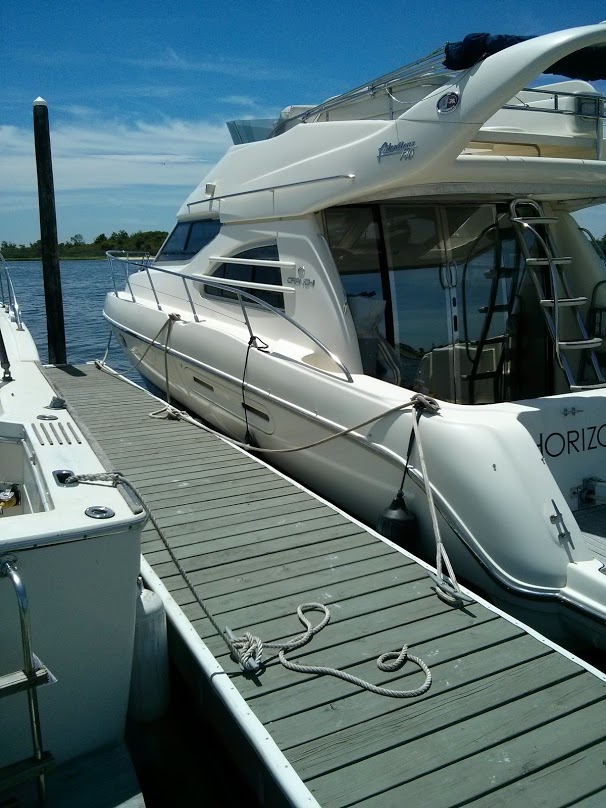
Here are a couple of pictures, first is the finger with the piling at the end. Piling is probably 18-20ft high at low tide.

dock1.jpg


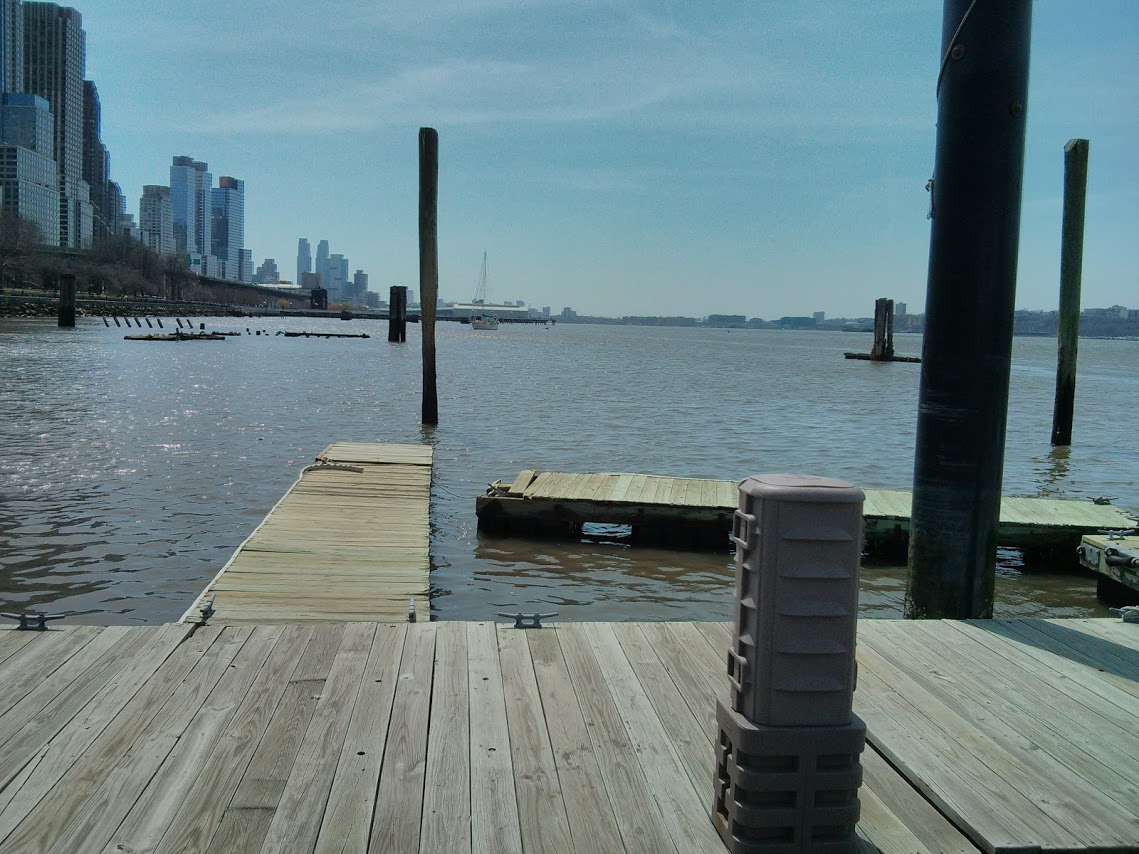
Second picture is of the piling at the back of the boat when backing in where we normally keep the 30 inch round fender. Pretty much the same height. Another piling about 4-6ft to the right of this one out of the picture. We use tideminders on that one going to the boat's starboard center cleat. Picture taken after Sandy hence the broken fingers.

dock2.jpg


Not sure how to keep lines set up on the dock for quick grabs, we usually keep the lines on the boat.

Right now I'm leaning towards getting some professional help and practice, practice, practice.

Note that we do have a lower helm but visibility backing in "seems" better from up top.

Sorry for the long winded posts.
 
Do your conditions change direction a lot as clearly this is easier to deal with if you are usually pushed toward the finger jetty where you can protect the boat and jetty with either permanent or temporary fenders and can hold the boat until you get the lines set up. Where we are we regularly have two weather conditions every day one from the east and one from the south west with the change late morning and in any event it is not hard to get forewarning of the wind and tide directions. If I am singlehanded I can time my return to the slip to get the best advantage of the conditions.
 
There are a lot of devices you can mount to the dock that would aid in holding the lines up making it easier for you wife to grab without stepping of the boat as long as she can get a couple of lines on the boat you can finish securing it yourself. I have an express style boat and I'm not a fan of docking by myself yes I have done it several times with decent conditions I would try it along. This said what's important is for you and wife to have a game plan of how and what is needed for you to dock. What I have found to be way to common is the captain has no idea what he wants down and expects his wife to know what to do and then yells at her for making mistakes. Communication is key this does not mean yelling at each other that just leads to resentment toward the boat as well as each other. I have taught my wife to take charge of the docking (lines) even if someone comes to help she doesn't let them take charge she will give them a line and instructions as to what to do with it. Some of the worst docking jobs I have done I had the most help at the dock and the people at the dock were not familiar with my needs and tied to the wrong cleat or didn't tie at all and thought they were going to just pull me in but once the wind or current takes me I need a spring line to hold me to the dock while I use the motors to pull either forward or back to control the boat, No one is strong enough to hold this line. I say hire a captain to work with both you and your wife once you have a game plan you will be fine!
 
quote:

Originally posted by nyc_bob

Not sure how to keep lines set up on the dock for quick grabs, we usually keep the lines on the boat.


Look for things called "mooring whips," assuming your marina will allow you to add some minor hardware to the docks. A mooring whip out near the end of your finger pier might be able to serve up a pre-measured bow and forward spring line simultaneously.

Assuming you pause momentarily while they're in reach from the fattest part of your boat (just ahead of the saloon windshield?) so your wifey can grab both at the same time...

She should be able to quickly affix the spring to your mid-ship's cleat -- and then take the other line to the bow while you complete the entry into the slip.

Shouldn't take much more work from there. A mooring whip that serves you up a pre-measured stern line crossing from the main dock to your starboard stern cleat might be an additional tweak.

Once you've got a forward spring, bow, and that stern line on, you're docked.

Carry "traveling lines" with you when you go somewhere else.

-Chris
 
First the lines stay on the dock, you don't take them with the boat,

Then on a boat that size with the door open the visibility from te lower helm shouldbe good enough, maybe even better as you will the dock. It places you closer to the lines. That brown pedestal seem to be pretty much centered and you shoul see it from the helm to center the boat.

With no pilings between slips. It s almost impossible not to touch the next boat. Just have two or three ball fenders deployed before coming in. On the port side, see if you can attach teh fenders to the finger pier so you don't have to spend all that time setting up fEnders averytime.

I would leave the bow line and a long spring line on that forward piling. Can't see if the new piling is wood, if it is put in a screwed hook, make a wooden hook and clamp it using to oversize hose clamps. Put it at a height that's easy for your wife to reach without having to use a boat hook. Coming in the slip, th spring should be the first line in, this way you know you will not hit the dock with the stern. Takes the pressure off everyone, next the bow line to prevent the bow from drifting.

As you back in and put tension against the spring, reversing the stbd engine will keep your stern against the floating dock instead of swinging agaisnt your neighbor. If you have current or breeze coming from the back, it will also keep the boat in place.

Last find a way to make the lines easier to grab from the boat, especially the stern line. Could be as easy as a block of wood to have a gap under the line so it can be easily lifted with a boat hook. This should be the third line that is secured. Followed by the other stern line and the final spring.

And obviously no acrobatics stepping off the boat until it is secured.

If you follow these steps, as long as you can bring the boat close to the dock, some practice is probably all you need.

One last thing, don't overdo the bow thruster. Controlling th stern is more important as the bow has nowhere to go but follow the rest of the boat. Use it to prevent the bow from falling off into your neighbor until the bow line and spring is set but that s it. Keep it mind that when you pull the bow one way with the thruster, it will push the stern the other way.

But again, if you step the bow and spring on the piling, all your wife has to do is set the eyes over the two cleats and then you keep th boat in place against the spring with the stbd engine in reverse. Takes the pressure off your crew and gives you plenty of time.
 
"Not sure how to keep lines set up on the dock for quick grabs, we usually keep the lines on the boat."

That's complicating things. Keep your dock lines on the dock so they can be grabbed with a boathook and slipped onto the boat's cleats. Looking at your pictures, you're running 2 separate lines from your stern cleat to 2 dock cleats, and 2 separate lines from your bow cleat to 2 dock cleats. Simplify.

At the stern... you could run a single line between those 2 dock cleats, with a loop tied in it to slip over the boat's stern cleat. When you leave the dock, unhook from the boat cleat and drop the line onto the dock. When you return, grab the line with a boat hook and slip the loop onto the boat cleat. You're now secured at the stern in a single step. You can use your engine(s) to put the bow against the pier while you secure that.

You can make up the same line setup at the bow- a single line between the 2 dock cleats with a loop tied in it to slip over your boat's bow cleat.

My .02
 
IMO a smaller boat has the same problems the only difference is Less weight. That points me to the idea that she is trying to manhandle the boat. Perhaps she is expecting too much of herself. IMO the deck crews job is to simply put lines where they belong no stress or strain or acrobatics involved. It is the boat drivers job to get the boat in the proper position and hold it there for her to do so. No strength or special line skills should be required.

So you might benefit with some handling instruction but the better solution would be to move the boat someplace protected so that there is no stress in the docking situation. Perhaps then confidence and experience can be built in the both of you and make the boat fun as it should be. A little extra driving wont matter if you start to enjoy the boat more.
Baby steps in gentle conditions are the way to go. You wouldn't take a new driver onto a busy freeway at rush hour would you?
 
A set of non voice activated headphones will ease the communications.
 
quote:

Originally posted by pdecat

IMO a smaller boat has the same problems the only difference is Less weight. That points me to the idea that she is trying to manhandle the boat. Perhaps she is expecting too much of herself. IMO the deck crews job is to simply put lines where they belong no stress or strain or acrobatics involved. It is the boat drivers job to get the boat in the proper position and hold it there for her to do so. No strength or special line skills should be required.


Amen. Drives me nuts when I see lousy drivers making their crew make up form their inability to drive the boat. And while this is pretty common with small boats once you get up to 35/40 you simply do not manhandle the boat.

Sensitivity disclaimer, The above is a general statement not meant to imply this is the case here :)

Especially nowadays with bow thrusters and twin engines. You can easily lean the boat against the dock or pilings with the thruster and by splitting the gears (stbd reverse, port fwd) with some stbd rudder while the crew sets the lines.

And finlally, a smaller boat will probably not have a thruster and be lighter, more sensitive to wind
 
That is the wrong dock for many reasons. Too open, too much surge, poor design and maintenance. You could improve it but that would not solve the waves and surge problems.
 
I do not have a piling between the boat next to me and myself. I make sure to have plenty of fenders at the height of the bow rail of the sail boater next to me and I sometimes drift against him, especially when single handling.

One trick I have done is to have a bow line and quickly grab the outer piling and bring line back to bow cleat...this keeps bow from hitting his boat as I do not have a thruster. From there, work the stern close to dock, step off and grap the spring line then stern line.

Not easy but practice/practice/practice and use fenders!

Good Luck!!
 
Have you considered thrusters? I saw a 390 Sea Ray Motor Yacht (the ones that look like a high top sneaker) get in and out of some nasty current/windy slips with the aid of thrusters.
 
Back
Top