We owned a 30' 1986 SR and I thought the 34 would be a logical step up for us. It was a nice boat in its day with a good layout. We ended up with a bigger boat because of space needs. SRs of that era should be thoroughly tested for stringer and transom rot. It's very common. The windows also leak and the boat has a fabric headliner that stains when the water comes in. You will probably see stains and if not, run the boat in sloppy weather where water comes over the foredeck. Then check for wet spots down below. Walk the foredeck to check for oil canning, also common where water has rotted the core. Engine hours on the meter should be suspect as the meters were easily turned off by removing a wire under the dash or at the meter. Repowering may be in your future if the engines are original. If you find a boat that passes inspection, you will enjoy it.

You are using an out of date browser. It may not display this or other websites correctly.
You should upgrade or use an alternative browser.
You should upgrade or use an alternative browser.
Bigger Boat suggestions (Trojan 10 meter input)
- Thread starter gardnersf
- Start date
I would expect the 330s of that era to be comparable to my 93 370. Very similar appearance and style. Probably very similar build quality with the usual SR issues of leaks. While my 93 leaked like a sieve, it had no rot. I did add PSS seals to keep the bilge dry which goes a long way toward preventing rot. The hull was all glass so I did not worry about that rotting. I did have nagging suspicions about the decking but it passed a rigorous survey.I was forover removing water stains from the fabric head liner and replaced the fabric in the v-berth prior to selling it. My yard was never able to eliminate the deck/hull joint leaks. The boat's rub rails looked brand new after 11 years and we never had a hard docking to explain the leaks. The suspicion was the close, steep waves on Lake Michigan flexed the deck and let the water into the boat. This may be less of an issue with a 330 because it has a much shorter foredeck. I have to say my issues were invisible to friends that we boated with because the boat really held its appearance. But keeping it looking good required $$$$$. We bought the Tiara and leaks are a thing of the past.
sbw, that is very valuable insight. One thing about my current boat that I like is the absence of leaks. I did have a port hole start to leak, but the seal has just deteriorated over 17 years. It was an easy 1 hour fix to reseal. I think that leaking would drive me crazy
Hi again, I've done some additional research and have found a 1986 Trojan International 10 meter express local to me. We checked out the boat today and it was in remarkably good condition.
http://tinyurl.com/ysms3f
I've read the reviews by Pascoe and it seems to be a well built boat. It was in the Bertram-Trojan days. The gunwhales were wide and the foredeck was solid, flat and textured. 700+ hours on 454's. Price seems appropriate as well.
Does anyone have any experience on this boat? Anything to look for on a follow up inspection (Survey will come with any purchase of course. I had been looking at Formula 34's as well, but the one this broker had just sold.
One thing I loved on this boat was the large cockpit. Very versatile.
http://tinyurl.com/ysms3f
I've read the reviews by Pascoe and it seems to be a well built boat. It was in the Bertram-Trojan days. The gunwhales were wide and the foredeck was solid, flat and textured. 700+ hours on 454's. Price seems appropriate as well.
Does anyone have any experience on this boat? Anything to look for on a follow up inspection (Survey will come with any purchase of course. I had been looking at Formula 34's as well, but the one this broker had just sold.
One thing I loved on this boat was the large cockpit. Very versatile.

- Joined
- Feb 1, 2007
- RO Number
- 25075
- Messages
- 1,698
The Trojan International series was a groundbreaking design when it was introduced in 1981. Today the design advantages of the Delta-Conic hull are wiedly misunderstood by many, including Pascoe.
I am familiar with the Trojan's line of International series vessels and own a 10 meter which we repowered in 2005.
I will post a couple of published reviews after this post.
RWS
I am familiar with the Trojan's line of International series vessels and own a 10 meter which we repowered in 2005.
I will post a couple of published reviews after this post.
RWS
- Joined
- Feb 1, 2007
- RO Number
- 25075
- Messages
- 1,698
This article first appeared in the February 1987 issue of Sea Magazine. All or parts of the information contained in this article might be outdated.
Trojan International 10 Meter
A gutsy, avant-garde original
Peter Bohr
If you’re 47 years old, drive a Mercedes or a Corvette, operate your own business, have a net worth greater than $1 million, and enjoy power boats, then it’s not a bad bet that you also own a Trojan International series boat, probably a 10 Meter.
That’s the profile of the typical Trojan owner these days, according to a marketing survey just completed by the company.
Any boat builder – or automobile manufacturer or pasta machine maker, for that matter – would love to have customer demographics like that. And Trojan can thank its 33-foot International 10 Meter model for attracting such an upscale group.
It seems like only yesterday that Trojan surprised the American power boat industry with its avant-garde 10 Meter. But the boat is now in its seventh year and Trojan has sold nearly 600 of them.
The 10 Meter was a gutsy move for a staid builder like Trojan. For some 35 years the folks at Trojan’s plant in Lancaster, PA had been quietly turning out nice, conservative family cruisers. “Boats built to a price,” is how several marine surveyors described older Trojans to me.
The early Trojans were of course constructed of wood. When the company switched to fiberglass in the late 1960s, the status of Trojan boats moved upward a notch. But despite the change of materials, the designs remained much the same, hardly distinguishable from Chris-Crafts, Owens or boats from a dozen other American builders.
Then around 1980, Trojan president Don Seith took a flier. Armed with the progressive ideas of naval architect Harry Schoell, he convinced Trojan’s parent company, Whittaker Corporation, that Trojan should build a trend setting, new kind of cruiser. Inspired by the ultra costly, ultra chic boats from Italian builder Riva, Schoell developed his own rendition of Riva’s “Med-style” boat.
The 10 Meter’s lines, inside and out, are excitingly different from most cruisers, as different as a Chevrolet Corvette from a Ford Country Squire. With its long, sleek, downward sloping foredeck, the boat resembles some wild beast ready to pounce on its prey. Below deck, the 10 Meter is filled with modernistic curved bulkheads that not only make the interior seem more like the cabin of a Lear Jet than a yacht, but are also very space efficient.
“The boat’s visual appeal initially catches the interest of buyers,” says George Rinderspacher of Pacific West Yachts in Newport Beach. “However, it’s the boat’s performance that finally grabs them.” George ought to know; he sold 24 new Trojans in 1986.
Indeed the 10 Meter’s success is based on more than sexy styling. Harry Schoell came up with an innovative hull to go with the 10 Meter’s innovative lines topside. The hull, called the “DeltaConic” design by Trojan, has unusual 18-inch wide, horizontal chines that run from bow to stern on either side. In between the chines is a more usual modified V-hull, one that’s quite deep at the bow but flattens out toward the stern.
What makes the 10 Meter truly different from other boats is its almost uncanny stability. The 10 Meter’s wide beam combined with the wide chines quickly stills any rolling motion. I’ve never been aboard a similar sized boat that felt as stable at dockside as this Trojan. Under way, the chines make the boats feel – to use an old car salesman’s cliché – like it corners on rails. Mind you, steering response isn’t especially quick. But the boat’s attitude is solid and secure as those chines lock in for the turn.
The 10 Meter’s standard twin 350 Crusader engines use a combined total of 18 gallons of gasoline per hour at a cruise speed of 28 to 30 miles per hour, according to George Rinderspacher. An AquaSonic muffler system that vents exhaust out the sides of the hull beneath the waterline is integrated into the hull during its layup. The system make the 10 Meter an unusually quiet power boat whether idling in the slip or running full bore.
The 10 Meter’s hull is solid fiberglass, but the decks and cabin side are cored with end grain balsa. My marine surveyor/advisors all commented that Trojan’s gelcoat work on the 10 Meter appeared to be of high quality.
Trojan also uses some innovative construction methods on the boat. For instance, the company vacuum bonds certain parts of the boat together. Liners are literally sucked against the hull by a vacuum pump until a resin and glass paste hardens. The technique gives a very uniform tight fit.
The 10 Meter comes in three versions. The Express, which made its debut at the Miami Boat Show in February 1981, came first. Like all the versions of the 10 Meter, the Express has a forward stateroom down below as well as a large galley, a dinette and a head. The helm and cockpit on the Express are essentially a single area, providing a huge arena for playing, partying or sun worshipping. And that’s exactly how most owners use their 10 Meters, according to the company’s survey.
The slightly more conventional-looking Sedan has a streamlined flying bridge, a saloon with a convertible sofa, and a severely abbreviated cockpit. A good configuration for cooler climes, the Sedan was introduced in early 1982.
The Mid-Cabin went into production in 1985. The exterior profile of this version is virtually identical to the Express. But the Mid-Cabin has a small sleeping area for two (with sitting headroom only) tucked under the helm.
Last year Trojan introduced a stretched version of the 10 Meter, called the 10.8 Meter (35 feet). It’s a 10 Meter Sedan with an extended cockpit and is aimed at the sportfishermen.
There have been no major changes in the basic 10 Meter design since its introduction in 1981. However, in one fell swoop in 1983, Trojan made some 200 detail changes. These included such things as upgraded interior fabrics, new instrumentation for the helm, and heavier stainless steel port lights. At the same time, Trojan abandoned what surely must have been one of the all-time worst gimmicks aboard a small yacht: electrically operated doors to the forward stateroom and head compartment. They were indeed attention getters at boat shows, but a marine environment is not exactly ideal for electric motors.
Don Seith’s gamble has obviously paid off handsomely for Trojan. The company still builds conventional cruisers (the “Classic” series), but their percentage of total sales has dwindled to 20 percent. Meanwhile, Harry Schoell’s 10 Meter has spawned a whole series of International boats, ranging from the 8.6 Meter (29 feet) to the 13 Meter (43 feet). Moreover, other American power boat manufacturers have fallen all over themselves to come up with Med-style boats of their own.
To be sure, a Trojan International 10 meter is not for everyone. But then neither is a Corvette.
This article first appeared in the February 1987 issue of Sea Magazine. All or parts of the information contained in this article might be outdated.
Trojan International 10 Meter
A gutsy, avant-garde original
Peter Bohr
If you’re 47 years old, drive a Mercedes or a Corvette, operate your own business, have a net worth greater than $1 million, and enjoy power boats, then it’s not a bad bet that you also own a Trojan International series boat, probably a 10 Meter.
That’s the profile of the typical Trojan owner these days, according to a marketing survey just completed by the company.
Any boat builder – or automobile manufacturer or pasta machine maker, for that matter – would love to have customer demographics like that. And Trojan can thank its 33-foot International 10 Meter model for attracting such an upscale group.
It seems like only yesterday that Trojan surprised the American power boat industry with its avant-garde 10 Meter. But the boat is now in its seventh year and Trojan has sold nearly 600 of them.
The 10 Meter was a gutsy move for a staid builder like Trojan. For some 35 years the folks at Trojan’s plant in Lancaster, PA had been quietly turning out nice, conservative family cruisers. “Boats built to a price,” is how several marine surveyors described older Trojans to me.
The early Trojans were of course constructed of wood. When the company switched to fiberglass in the late 1960s, the status of Trojan boats moved upward a notch. But despite the change of materials, the designs remained much the same, hardly distinguishable from Chris-Crafts, Owens or boats from a dozen other American builders.
Then around 1980, Trojan president Don Seith took a flier. Armed with the progressive ideas of naval architect Harry Schoell, he convinced Trojan’s parent company, Whittaker Corporation, that Trojan should build a trend setting, new kind of cruiser. Inspired by the ultra costly, ultra chic boats from Italian builder Riva, Schoell developed his own rendition of Riva’s “Med-style” boat.
The 10 Meter’s lines, inside and out, are excitingly different from most cruisers, as different as a Chevrolet Corvette from a Ford Country Squire. With its long, sleek, downward sloping foredeck, the boat resembles some wild beast ready to pounce on its prey. Below deck, the 10 Meter is filled with modernistic curved bulkheads that not only make the interior seem more like the cabin of a Lear Jet than a yacht, but are also very space efficient.
“The boat’s visual appeal initially catches the interest of buyers,” says George Rinderspacher of Pacific West Yachts in Newport Beach. “However, it’s the boat’s performance that finally grabs them.” George ought to know; he sold 24 new Trojans in 1986.
Indeed the 10 Meter’s success is based on more than sexy styling. Harry Schoell came up with an innovative hull to go with the 10 Meter’s innovative lines topside. The hull, called the “DeltaConic” design by Trojan, has unusual 18-inch wide, horizontal chines that run from bow to stern on either side. In between the chines is a more usual modified V-hull, one that’s quite deep at the bow but flattens out toward the stern.
What makes the 10 Meter truly different from other boats is its almost uncanny stability. The 10 Meter’s wide beam combined with the wide chines quickly stills any rolling motion. I’ve never been aboard a similar sized boat that felt as stable at dockside as this Trojan. Under way, the chines make the boats feel – to use an old car salesman’s cliché – like it corners on rails. Mind you, steering response isn’t especially quick. But the boat’s attitude is solid and secure as those chines lock in for the turn.
The 10 Meter’s standard twin 350 Crusader engines use a combined total of 18 gallons of gasoline per hour at a cruise speed of 28 to 30 miles per hour, according to George Rinderspacher. An AquaSonic muffler system that vents exhaust out the sides of the hull beneath the waterline is integrated into the hull during its layup. The system make the 10 Meter an unusually quiet power boat whether idling in the slip or running full bore.
The 10 Meter’s hull is solid fiberglass, but the decks and cabin side are cored with end grain balsa. My marine surveyor/advisors all commented that Trojan’s gelcoat work on the 10 Meter appeared to be of high quality.
Trojan also uses some innovative construction methods on the boat. For instance, the company vacuum bonds certain parts of the boat together. Liners are literally sucked against the hull by a vacuum pump until a resin and glass paste hardens. The technique gives a very uniform tight fit.
The 10 Meter comes in three versions. The Express, which made its debut at the Miami Boat Show in February 1981, came first. Like all the versions of the 10 Meter, the Express has a forward stateroom down below as well as a large galley, a dinette and a head. The helm and cockpit on the Express are essentially a single area, providing a huge arena for playing, partying or sun worshipping. And that’s exactly how most owners use their 10 Meters, according to the company’s survey.
The slightly more conventional-looking Sedan has a streamlined flying bridge, a saloon with a convertible sofa, and a severely abbreviated cockpit. A good configuration for cooler climes, the Sedan was introduced in early 1982.
The Mid-Cabin went into production in 1985. The exterior profile of this version is virtually identical to the Express. But the Mid-Cabin has a small sleeping area for two (with sitting headroom only) tucked under the helm.
Last year Trojan introduced a stretched version of the 10 Meter, called the 10.8 Meter (35 feet). It’s a 10 Meter Sedan with an extended cockpit and is aimed at the sportfishermen.
There have been no major changes in the basic 10 Meter design since its introduction in 1981. However, in one fell swoop in 1983, Trojan made some 200 detail changes. These included such things as upgraded interior fabrics, new instrumentation for the helm, and heavier stainless steel port lights. At the same time, Trojan abandoned what surely must have been one of the all-time worst gimmicks aboard a small yacht: electrically operated doors to the forward stateroom and head compartment. They were indeed attention getters at boat shows, but a marine environment is not exactly ideal for electric motors.
Don Seith’s gamble has obviously paid off handsomely for Trojan. The company still builds conventional cruisers (the “Classic” series), but their percentage of total sales has dwindled to 20 percent. Meanwhile, Harry Schoell’s 10 Meter has spawned a whole series of International boats, ranging from the 8.6 Meter (29 feet) to the 13 Meter (43 feet). Moreover, other American power boat manufacturers have fallen all over themselves to come up with Med-style boats of their own.
To be sure, a Trojan International 10 meter is not for everyone. But then neither is a Corvette.
This article first appeared in the February 1987 issue of Sea Magazine. All or parts of the information contained in this article might be outdated.
- Joined
- Feb 1, 2007
- RO Number
- 25075
- Messages
- 1,698
Cutting Edge Cruiser - Trojan 10 Meter Express
________________________________________
by Peter Bohr
Trojan's 10 Meter Express has 'the look'
Print This Article | Email This Article
"Euro-style" or "Med-style" -- call it what you will. But peruse any harbor, and you'll see plenty of examples of "the look."
Low, sleek and powerful, the Euro-style boat is as different from the traditional boxy power cruiser as Hillary Clinton is from Rush Limbaugh.
It was Trojan Yachts, formerly of Lancaster, Pennsylvania, that first brought the look to this country. When Trojan's 10 Meter International Series Express made its debut in 1981, it launched a new kind of family cruiser that's since been embraced by most American boat builders, from Bayliner to Tiara.
Besides giving the boat a sexy profile, the bold styling of Trojan's 10 Meter has several functional advantages over the usual flying bridge sedan cruiser of the day. The huge cockpit beneath the radar arch is the perfect place for sunning or partying.
And because the helm is in the cockpit -- not high above on the bridge -- the skipper isn't removed from any socializing in the cockpit. Nor does the skipper have to sprint up and down steps to handle lines, which makes dockside maneuvers much easier.
The Trojan 10 Meter's avant-garde look doesn't stop there. Belowdecks, the cabin is filled with modernistic curved surfaces and lush decor. On the earliest 10 Meters, the curved bulkhead door leading to the forward stateroom was even electrically operated, like something from the starship ,/Enterprise.
But once again, there is function in the form. Instead of unusable voids made by the sharp corners of square bulkheads, the 10 Meter's curved panels make for a more spacious and comfortable interior. "We didn't want people to get beat up by the corner of a table," said Harry Schoell, the 10 Meter's designer.
The boat's visual appeal alone might have made it a marketplace hit. But Schoell also came up with an innovative hull to go along with the 10 Meter's innovative lines topside.
Schoell's patented DeltaConic hull design has 18 inch wide horizontal chines that run from bow to stern on either side. In between the chines, the modified-V hull is deep at the bow and flatter toward the stern.
It all works remarkably well. The 10 Meter's wide body, combined with the wide chines, provides a remarkably stable and dry ride. Steering response isn't especially quick, but the boat feels solid and secure when those wide chines lock in for a turn.
With its standard twin 350 Crusader gasoline engines, the 10 Meter has a decent turn of speed -- though the boat isn't as fast as it looks to some people. The top speed is in the mid-30 mph range, and cruising speed is around 25 to 28 mph.
At cruising speed, the pair of Crusaders will burn about 20 gallons an hour combined. Diesels were an option, though never a popular one.
The original 10 Meter Express was eventually joined by a more conventional-looking 10 Meter flying bridge sedan (in 1982) and a 10 Meter midcabin design (in 1985). The latter model looks almost identical to the Express on the outside, but has a small sleeping area for two tucked under the helm.
The 10 Meter was not only a success in creating a whole new genre of cruiser in America, but it was a sales success for its builder. Between 1981 and 1989, Trojan sold more than 600 of these boats.
But alas, the company's fortunes were not all so sweet. After nearly 40 years of boat building, venerable Trojan entered bankruptcy. In 1992, the company's remains were purchased by Carver Boat Corp.
But happily for the owners -- and prospective owners -- of Trojan's 10 Meter Express, these boats are not orphans. Carver has retained a parts supply organization in Lancaster that can provide virtually anything for the 10 Meters (or almost any Trojan built since the late 1960s, for that matter) -- from radar arches to grabrails.
By all accounts, the 10 Meter hulls were stoutly constructed. Some boats built during 1985 and 1986 were afflicted with hull blisters, but most of these were permanently repaired under warranty by Trojan -- at a cost of about $10,000 a job.
In your search for a 10 Meter Express, keep in mind those acres of exposed cockpit. Though the earliest editions were rather sparsely outfitted, later boats had all manner of upholstered seats, wet bars and the like, which can deteriorate rapidly in the sun.
Moreover, according to surveyor Bunker Hill of Maritime Consultants in Newport Beach, these Trojans' interior cabinetry and fittings weren't especially durable. So you may have to perform some cabin refurbishing as well.
A new 10 Meter Express carried a base price of $74,500 in 1981,
and the price tag rose to just over $100,000 by the end of its production run. Today, expect to pay between $45,000 and $95,000.
________________________________________
This article first appeared in the July 1994 issue of Sea Magazine. All or parts of the information contained in this article might be outdated.
________________________________________
by Peter Bohr
Trojan's 10 Meter Express has 'the look'
Print This Article | Email This Article
"Euro-style" or "Med-style" -- call it what you will. But peruse any harbor, and you'll see plenty of examples of "the look."
Low, sleek and powerful, the Euro-style boat is as different from the traditional boxy power cruiser as Hillary Clinton is from Rush Limbaugh.
It was Trojan Yachts, formerly of Lancaster, Pennsylvania, that first brought the look to this country. When Trojan's 10 Meter International Series Express made its debut in 1981, it launched a new kind of family cruiser that's since been embraced by most American boat builders, from Bayliner to Tiara.
Besides giving the boat a sexy profile, the bold styling of Trojan's 10 Meter has several functional advantages over the usual flying bridge sedan cruiser of the day. The huge cockpit beneath the radar arch is the perfect place for sunning or partying.
And because the helm is in the cockpit -- not high above on the bridge -- the skipper isn't removed from any socializing in the cockpit. Nor does the skipper have to sprint up and down steps to handle lines, which makes dockside maneuvers much easier.
The Trojan 10 Meter's avant-garde look doesn't stop there. Belowdecks, the cabin is filled with modernistic curved surfaces and lush decor. On the earliest 10 Meters, the curved bulkhead door leading to the forward stateroom was even electrically operated, like something from the starship ,/Enterprise.
But once again, there is function in the form. Instead of unusable voids made by the sharp corners of square bulkheads, the 10 Meter's curved panels make for a more spacious and comfortable interior. "We didn't want people to get beat up by the corner of a table," said Harry Schoell, the 10 Meter's designer.
The boat's visual appeal alone might have made it a marketplace hit. But Schoell also came up with an innovative hull to go along with the 10 Meter's innovative lines topside.
Schoell's patented DeltaConic hull design has 18 inch wide horizontal chines that run from bow to stern on either side. In between the chines, the modified-V hull is deep at the bow and flatter toward the stern.
It all works remarkably well. The 10 Meter's wide body, combined with the wide chines, provides a remarkably stable and dry ride. Steering response isn't especially quick, but the boat feels solid and secure when those wide chines lock in for a turn.
With its standard twin 350 Crusader gasoline engines, the 10 Meter has a decent turn of speed -- though the boat isn't as fast as it looks to some people. The top speed is in the mid-30 mph range, and cruising speed is around 25 to 28 mph.
At cruising speed, the pair of Crusaders will burn about 20 gallons an hour combined. Diesels were an option, though never a popular one.
The original 10 Meter Express was eventually joined by a more conventional-looking 10 Meter flying bridge sedan (in 1982) and a 10 Meter midcabin design (in 1985). The latter model looks almost identical to the Express on the outside, but has a small sleeping area for two tucked under the helm.
The 10 Meter was not only a success in creating a whole new genre of cruiser in America, but it was a sales success for its builder. Between 1981 and 1989, Trojan sold more than 600 of these boats.
But alas, the company's fortunes were not all so sweet. After nearly 40 years of boat building, venerable Trojan entered bankruptcy. In 1992, the company's remains were purchased by Carver Boat Corp.
But happily for the owners -- and prospective owners -- of Trojan's 10 Meter Express, these boats are not orphans. Carver has retained a parts supply organization in Lancaster that can provide virtually anything for the 10 Meters (or almost any Trojan built since the late 1960s, for that matter) -- from radar arches to grabrails.
By all accounts, the 10 Meter hulls were stoutly constructed. Some boats built during 1985 and 1986 were afflicted with hull blisters, but most of these were permanently repaired under warranty by Trojan -- at a cost of about $10,000 a job.
In your search for a 10 Meter Express, keep in mind those acres of exposed cockpit. Though the earliest editions were rather sparsely outfitted, later boats had all manner of upholstered seats, wet bars and the like, which can deteriorate rapidly in the sun.
Moreover, according to surveyor Bunker Hill of Maritime Consultants in Newport Beach, these Trojans' interior cabinetry and fittings weren't especially durable. So you may have to perform some cabin refurbishing as well.
A new 10 Meter Express carried a base price of $74,500 in 1981,
and the price tag rose to just over $100,000 by the end of its production run. Today, expect to pay between $45,000 and $95,000.
________________________________________
This article first appeared in the July 1994 issue of Sea Magazine. All or parts of the information contained in this article might be outdated.
- Joined
- Feb 1, 2007
- RO Number
- 25075
- Messages
- 1,698
March 1996
Trojan: Used-Boat Survey
Trojans run the gamut from classic cruisers to International Euro-styled express boats, to the new Carver/Trojan ultramoderns; owners may not like other Trojans, but most are quite satisfied with their own boats.
As in 1992, owners gave the Classic 32, one
of the most popular boats of its size and class
ever built, high ratings for value and overall
satisfaction.
Trojan Yachts, yet another reputable builder with a new lease on life, nevertheless has something of a split personality. Among its customers there are the owners of the “classic” Trojan cruisers that spanned the 1970s and 1980s; there are the owners of Trojan’s International Series of stylized Euro-cruisers, introduced in 1986; and there are the owners of the “new” Trojans, built since 1993 under the aegis of Carver Boats.
Few Trojan owners can relate to model types outside of their own class—a phenomenon we’ve seen with other makes, including Mainship and Chris Craft—and the mixed results can be seen in our latest survey. While owners as a whole are perfectly happy with their own boats, rating them a solid B, and would gladly buy another (if possible), most have no desire to possess a Trojan from another series. This explains in part why only 72 percent of those who own older Trojans—one of the lowest scores we’ve seen in our used-boat surveys—said they would buy another Trojan. Even many of the “yes” votes contained a caveat summed up by the owner of a 1990 10.8 Meter express cruiser: “Yes. But not one of the current models.”
The good news is that there are many excellent values out there, especially for those seeking one of the F-series of classic 32- and 36-foot Trojans. As we learned in our last survey of Trojan boats in 1992, these older cruisers have held up well, both in physical condition and value.
The Company...
Trojan has been building boats for a long time, beginning as a manufacturer of plywood runabouts, in the 12-16-foot range, in 1949. After buying out a bankrupt builder from New York, Trojan set up shop in a dairy barn in Lancaster, Pennsylvania, well-known for the woodworking abilities of its Amish and Mennonite residents. “They were very conscientious and did extremely fine work,” remembers Larry Warner, who worked at Trojan for 35 years.
Trojan expanded into the cruiser/motor yacht market in 1966 after buying out the Shepherd Boat Company in Ontario. A number of 32 and 36 footers were built in Canada before Trojan consolidated operations at Lancaster. By 1970, the company had switched from wood to fiberglass (at which time, many of the local craftsmen packed up their woodworking tools and departed, declining to work with plastic) and began building some of its classic models, including the F-32 and F-36 cruisers.
The company (along with Bertram Yachts) was bought by the Whittaker Corporation of California in the late 1970s and began down a familiar path of corporate swaps that led to downsizing, lack of retooling, and, eventually, stagnation. In the interim, however, the builder was one of the first to embrace the new Euro-look, turning out some innovative and not entirely unsuccessful models built on Harry Schoel’s Delta Conic hull. But the new look was adopted by others, most notably Sea Ray, who could crank out comparable models for much less than the cost of a Trojan. Nor did the traditional Trojan customer embrace the new International series, although Warner will say that “they’re a pretty good-looking boat.”
Trojan, like Bertram and many others, filed for bankruptcy and was rescued in 1993 when Carver, part of the Genmar group, picked up the assets and began building its own interpretation of the International line. The latest line began with a single model, the 370 (now the 390), added a 350 in 1994, and a 440 last year. (The new owner also destroyed the old Trojan hull molds, a source of dismay for many old customers.) “Carver reinvented the 37-foot Trojan, the old 11 Meter, but they could make it for 30 percent less than Trojan could,” says Larry Russo of Russo Marine in Medford, Massachussets, who took on the line in 1992. As a result, he said, Carver/Trojan has “tapped into a whole new market” and is doing very well with its sleek Express Yachts. Still, Russo concedes that “There are a lot of (classic) Trojan boats on the water that have stood the test of time.”
The Survey Shows...
Not surprisingly most of those who responded to our survey—90 percent— were owners of older Trojans. Of these, 37 percent owned one of the Classic 32s, one of the most popular boats of its size and type ever built; 24 percent owned a version of the Classic 36, and 24 percent owned one of the newer Internationals—10, 10.8, 11, or 12 Meters.
Each of these groups has its own prejudices, with 32 owners feeling the 36 was not a very successful upsizing of the smaller sedan/flying bridge model, but both uniting in their disdain for the Euro-style express boats, whether built by the original or the Carver-owned Trojan companies. (“Carver” is something of a misnomer; while the 350 and 390 are built at the Carver plant in Wisconsin, the 440 is being made at the Hatteras facility in North Carolina.)
Owners of the International series, produced from 1986 through 1992, have little regard for the stodgy “traditional” Trojans and tend to reject the latest express cruisers, primarily because Carver has jettisoned the Delta Conic hull, famous for its soft ride. New Trojan owners, on the other hand, represent a whole new market, as Russo observed, who have made their comparisons not with previous Trojans, but with makes such as Tiara, Sea Ray, and Formula.
Among the groups, Classic 32 owners showed the highest overall satisfaction rating, 87.5, compared to 82.5 percent for 36 owners and 80 percent for 10 Meter owners. And more than 92 percent of 32 owners felt their boats were holding their value well—the only A rating in this category. These results vary somewhat from four years ago, when Classic 36 owners posted the highest rating for overall satisfaction, followed by the 32 and 10 Meter boats.
Trojan owners collectively listed an approval rating of 82.5 percent, on a par with Bayliner owners (PBR, July 1995), but several percentage points lower than Chris-Craft (another company with a fragmented customer base), and well below Carver owners, for example, in our most recent survey. As a group, however, Trojan owners gave a respectable B rating for the value of their boats, higher than Sea Ray or Mainship owners and second only to Carver.
As they did in 1992, Classic 32 owners gave their boats A ratings for interior layout—one of the boat’s undeniable strong points—and low-speed, or docking, handling. Low-speed handling, in fact, got high ratings all around. Owners of the 32 gave their lowest approval rating—77 percent—for layout of the helm; only 10 Meter owners, at 75 percent, rated their helms lower. Classic 36 owners, by comparison, gave interior layout a B- (Trojan gave the 36 two extra feet of cockpit and expanded the saloon, but stole space from an already cramped galley). The bigger boat—no surprise here—also received higher marks, solid Bs, for sleeping accommodations and cockpit/deck layout.
The 10 Meter, typical of the express cruisers, posted the highest grade, a perfect 100, for performance (credit the Delta Conic hull, once again), but just a C for its helm station and a C- for its cramped (and oddball) berthing arrangements.
As in most other survey’s we’ve done, owners of newer boats were generally more satisfied, especially in the fit & finish and performance categories. Naturally enough, boats built between 1986 and 1992—a mixture of old-style and express cruisers—got the best marks for value. Many of these marks are, of course, subjective, and in certain areas, specifically resale value, perception doesn’t necessarily mesh with reality.
Owners Tell Us...
Owners of Classic 32 and 36 models have, in many cases, long years of experience with their boats and thus few illusions. They also operate from the perspective of being able to compare their boats to newer boats. As a result, outdated helms, galleys, and heads tend to be downgraded when compared to their better-equipped and more ergonomic counterparts on contemporary boats.
Trojan made few major changes to the 32 Flybridge Sedan over its lifespan (1973-1992), during which some 2,700 models were sold, making it a best-seller by any standard. One was to make the lower, secondary steering station optional (everyone steers from the flying bridge, anyway) and a second was to replace the earlier V-berth with a center island berth.
Obviously, the boat, as originally designed, appealed to a broad range of buyers. One of its appeals is its clean and simple lines. “The boat is very attractive—everybody comments on it,” wrote the owner of a 1987 boat based on Florida’s west coast. Although the cockpit is fairly short—about six feet—for this size boat, most owners seem willing to make the tradeoff for extra room in saloon, which is open and airy, with lots of headroom. “This boat has a better interior layout than any other 32-foot ‘modern-style’ boat I have seen,” said another Florida owner, who bought his 1988 model used in 1991.
Built of standard, but solid, chopped strand and 24-ounce woven roving, the Classic hulls have aged well. In fact, the survey was devoid of complaints about structural defects, except for minor fit and finish problems. “It’s a good solid boat for the money,” said the owner of the 1987 boat in Florida. “I haven’t spent anything except for engine work, generator work, canvas, and bottom paint.”
The most common complaint about the 32 was its handling at speed, especially in any kind of sea. “I bought this boat new and it would broach when running with a following sea,” said the owner of a 1988 model. He corrected the broaching problem by installing larger rudders, but then found his hydraulics were inadequate to operate the rudders. This owner was one of just a few 32 owners who said he wouldn’t buy another Trojan. Another reader said the modified-V hull (9 degrees deadrise aft) “pounds terribly in a short chop, but goes straight without having to hold on to the steering wheel.” Yet another owner complained about inadequate fuel capacity (120 gallons) on his 1980 model; later versions carried 220 gallons in dual tanks (and some buyers added saddle tanks).
The newer International cruisers, as noted, posted a perfect score for high-speed handling and a strong A for docking maneuverability. “Stability is outstanding and docking is made easier by the width of the walkaround,” said the Maryland owner of a 1987 10 Meter. The same owner, however, complained about difficult access to the twin 454 engines, a common lament by owners of the 36 as well. Satisfaction with performance was almost universal throughout the express cruisers. “The ride of the Delta Conic hull is amazing. It will take far more pounding than we can,” commented David Cohen of Maryland, who owns a 1990 8.6 Meter. Still Cohen feels his outdrive trim is “ridiculously sensitive” and repeated the familiar complaint about difficult engine access.
Smallest of the Trojan Internationals, the
29-foot 8.6 Meter is a bit dated in looks, but
runs well on its Delta Conic hull.
The Classic 36 was produced in several configurations, including the Tri Cabin introduced in 1970 and the popular 36 Convertible, which arrived two years later; both were available with alternative interior layouts. Although the 36s, as a group, received just a C rating for fit and finish (with some justification), the hulls appear to be as solid as other Trojan boats, with no reports of major problems or gelcoat blistering (although we saw some signs of minor gelcoat crazing and worn nonskid). Writes one owner, of a 1982 Tri Cabin in Washington State, “I have hull plugs from a 34-foot Tollycraft; the Trojan plugs are thicker.” Kim Pollack, who cruises a 1987 model on Chesapeake Bay, said the “gelcoat (when waxed) still looks new, the stainless is in great shape, (and) the engines (with almost 600 hours on them) don’t burn or leak any oil. We can efficiently cruise at 9 knots on about 6 gallons/hour.”
While the 36s got a higher (B) rating for cruising than the 32s, there were complaints here as well. One owner said his 1974 model handled well at lower speeds, but at about 17 knots tended to nod from side-to-side, requiring lots of steering. Several owners also felt the 36, with twin 350s, was underpowered.
Jim Korney, who charters his 1972-vintage 36 Convertible out of Newport, Rhode Island, is one of many owners of older versions who has faced the repowering issue. Korney chose to replace the existing 350 Mercs with 454 Chevy blocks, partly because of initial cost savings, but has had second thoughts about not going with diesel-power for more fuel economy (and range). He has made some alterations to the boat, notably replacing the aft deck (adding a higher crown for better drainage), but otherwise praises the boat for its handling, deck layout, and enclosed saloon, which provides refuge for his charter fishing parties. “The boat’s well designed for what I use it for,” he said.
Larry Warner, who now helps run Marine-Tech in Lancaster, which supplies replacement parts for older Trojans (see Contacts), said many customers choose diesel power when the gas engines give out. He recommends one of the smaller Cummins diesels or, for larger boats, the Caterpillar 3116.
Our Inspection Showed...
While most of the Trojans we saw in the water were of the classic variety, we did get a close look at some of the International models as well as the 350 and 370/390 newcomers from the new Trojan. Euro-styling or not, some of the International models, such as the 8.6 Meter sport a truncated look, with lots of bow but not much in the way of stern. The resulting aft “cabin” is too small for adults, but overnighters have the compensation of a pedestal Queen-size berth at the bow.
On the 11 Meter Express, the hull styling (and size: the beam is 14 feet) create an open feeling below, despite a lack of natural lighting; but again the master stateroom, aft of the head, is cramped and contorted in dimension. But it’s either that or stretch out in the open dinette/lounge area, where a Rube Goldberg arrangement converts part of the sofa into a bunk. We didn’t see any evidence of it, but several Express owners reported small, annoying leaks window leaks.
At 38 feet, with a beam of 12 feet, the 350 can be considered the successor to the old 11 Meter. So why does it feel so small for its size on deck? Well, from the length, you can subtract the 30 inches of swim platform as well as the bow pulpit. From the width, there are 10-inch sidedecks in the cockpit, plus furniture and other obstructions. We measured six feet by three feet of walkable sole in the aft cockpit.
We were unable to get any design or construction details from Trojan, despite several calls to the Wisconsin plant. A brochure said the line, from hull to interiors, apparently, was the work of Fulvio DeSimoni Yacht Design of Milan. What we gathered from a look at one of their owner manuals was that the hull, like older models, is a fairly standard laminate consisting of chopped strand and woven roving, with a vinylester resin barrier below the water line for osmotic blistering protection. The hull-deck joint is the tried-and-true shoebox lid arrangment, fastened with Sikaflex and stainless steel screws, backed with plywood. Balsa wood, plywood, aluminum, and synthetic materials are used for coring in appropriate places “for stiffness and insulation,” according to the manual. Trojan provides a five-year hull warranty, including two years of blistering coverage.
Glasswork on the 1995 model we looked at appeared solid, above and below; fit and finish were okay, but not perfect (we found loose fibers inside a storage bin on deck, and a crude sealing job in a crack behind some cushions). Down below, the door to the portside head was sticking; the most noticeable lapses in finish involved installation of wood trim, where screw holes inside cabinets were left rough, and not all joints fit snugly. The woodwork wasn’t bad—but certainly not up to Lancaster craftsmen standards. After a season on the water, the smaller fittings had held up well; the only sign of rusting we saw was at the exhausts.
The main saloon of the 350 is fairly spacious, with about 6' 4" of headroom. Head, with shower stall, and galley are to port; the saloon settee is along the starboard side, beneath storage cabinets and a large AC and DC panel arrangment, which is behind a framed glass lift-up door—a neat arrangment that permits viewing without raising the lid.
The 33-foot 10 Meter International Express,
like its larger cousin, the 39-foot 11 Meter,
offers some good bargains for those who like
Euro-styled cruisers.
Instead of attemping to squeeze in an aft cabin, the 350 uses the step-down space under the helm area for another table and U-shaped settee. Separated as it is and with just over three feet of sitting headroom, this is a place you can send “bad” guests to take their cocktails. Although the boat is rated to sleep six, we’ll do our sleeping in the V-berth, thank you. There’s a respectable 35-40 inches of sitting headroom above the pedestal, or island, berth, which measures 75 inches by 56 inches at its longest and widest points. A Bomar hatch above lets in plenty of light and provides another exit; we found evidence of leaks/condensation along the interior, however. We’d fix that fast, and we’d definitely do something about the four mirror panels gracing the forward bulkhead. All in all, a fairly open space that may owe something to the somewhat bulging lines of the European hull style.
The 390 we climbed around was boat-show bright. Instead of the odd pedestal-type companionway steps on the 350, the 390 has a carpeted spiral stairway that provides one of the more elegant entrances to a boat we’ve seen. And while one International owner dismissed the new, Fulvio-inspired interiors as both “flashy” and “sterile,” we kind of liked the 390’s, which is done in off-white with maple trim. The 390 (LOA: 39' 4"; beam: 13' 6") seemed spacious, with a roomy settee to port and an efficient L-shaped galley opposite. There’s sufficient storage below and above the galley, but the slight edge of counter trim is more decoration than an actual fiddle.
The 390 (which was drawing a crowd) sports a somewhat more spacious lounge area in the after part of the cabin, and contains a proportionately larger stateroom in the bows. The cabin has its own entrance—always a welcome feature—to the comfortably-sized head to starboard, where a curved sliding door converts the head into a shower stall. There’s a lip to keep the water from draining into saloon or cabin, but expect some mopping up within the head. Of course, it’s hard to tell at a boat show how well everything will hold up; one owner of a 1993 370/390, while basically pleased with his boat (except for the head), reported failures of “three dozen little things”—cabinet hardware falling off, inoperable switches, nonworking spotlight and nav light, etc.
Both boats, like the new 440, have vinyl liners everywhere, including the inside backs of cabinets, which makes for easy cleaning and should cut down on the mildewing problems experienced by owners of older Trojans, both traditional and the European expresses, which had fabric covering and required much ventilating in the absence of a dehumidifier. We didn’t inspect a 440, but talked to an owner (who had broken ranks and moved up from an International), who says he is very happy with his new boat. Unlike its smaller cousins, the 440 has sufficient space for a full aft cabin, giving it two private staterooms. “It’s really the boat to buy, because it’s easy to live on,” said the new owner. “It’s really set up for living for a couple of weeks at a time, not a couple of days.” This owner also takes exception to the “glitzy” label: “It’s not slick, it’s sumptuous.”
The Used-Boat Market Tells Us...
Trojan owners feel strongly that their boats have held their value well. And in some cases they are accurate. Classic 32 owners felt the strongest, with 92 percent experessing confidence in the continuing value of their boats. According to the used-boat price guides, they are right, with a 1989 model, for example, declining just 29 percent in resale value (see Market Scan, pages 6-7). A 32-foot Bayliner motoryacht, by contrast, shows a loss of 43 percent of original value in just four years; a 1988 34-foot Mainship III also depreciated by 43 percent over the first six years; only Carver, which traditionally holds its value well, was close, with its 1988 Aft Cabin 2307 depreciating 31 percent in six years. The F-36 also has retained its value, according to the price guides, matching the 32 with just 29 percent depreciation for a 1989 model.
The pricing situation gets more complicated with the International express cruisers, some of which, in the last days of the old Trojan company, were selling for less than wholesale. Used-boat bargains were even greater, well below suggested prices in the used-boat guides. Daniel Coluccio of New Jersey said he paid less than $65,000 for a 1987 10 Meter Flybridge in 1993. “After some research,” he wrote, “I discovered that this boat had listed for about $150,000 in 1987!” The problem, as former Trojan dealers have said before, was not the quality of the boat, but the overpricing necessitated by Trojan’s production and financial troubles.
Bargains like this should result in severe depreciation of boats such as the 10 Meter but, in fact, the price guides are showing an average loss of 34 percent for the 1989 10 Meter. But then, the the ABOS Blue Book also shows, for the model with twin gas engines, a new-boat price of $119,900. But we talked with owners, who paid $125,000 and more for their 1989s. Prices for 10 Meters in a recent Soundings issue varied from $60,000 to about $80,000 for a 1987 model. Silvertons and Sea Rays could be considered competition for Trojan in these models. Although it’s difficult to find head-to-head comparisons, the 1989 Silverton 37 Convertible, according to ABOS and N.A.D.A., shows an average depreciation of 40 percent, the 1990 Sea Ray 350 a drop of 30 percent.
Faltering production left a few orphan Trojan models, almost one-offs and with little (we’d guess) popular appeal. The 8.6 Meter, the smallest of the International expresses, was built from 1988-1990, but not in any great numbers. At 29 feet, with its squared-off transom, it lacks both looks and interior space. As one (not entirely dissatisfied) owner said, “I should have realized that while I was buying a 1990 look, I was also buying early 1980s engineering and design.” According to the price guides, The 8.6 has fared the worst among Trojans in the used market, with the 1989 version losing an average of 43 percent of its value in six years.
Conclusions/Recommendations
Mild confusion reigning in the Trojan field can work to the buyer’s advantage—if Trojan offers what you seek. Although there are fewer bargains among the classic 32 and 36 cruisers, there’s also more to value than price. It’s an even better deal if the previous owner(s) have repowered and upgraded equipment, as many have. Geoffrey Duncan of Safety Harbor, Florida has owned three classic 32s over the last 18 years. “I would consider pre-owned 32s and 36s on the market today, in good or above average condition, to be an extraordinary value for someone wanting a good buy in a used boat,” Duncan said.
If you like the styling, there are good values to be found among the International boats as well, especially the larger 11 and 12 Meters. While we haven’t encountered any tales of major structural problems among any of the Trojans, complaints about fit and finish and failures of small pieces of gear would prompt us to give these boats a careful inspection. And while you might be able to buy cheap, don't look for a great return at resale time.
Nor should you worry, as readers did during our ’92 survey, about being left without manufacturer support, with Larry Warner and John Leed, another Trojan veteran, supplying parts, including smaller moldings, for the early models. Marine-Tech drew praise from half a dozen readers for its friendly and competent service.
Trojan’s earlier woes, and uncertainty about the future under Carver, can also help the new-boat buyer. Chuck Willett of Boston, Massachusetts went to a boat show last year intending to buy a Sea Ray. When the dealer wouldn’t deal, Willett ended up with a Trojan 350 at a price he could afford and has no regrets. Although time (and a lack of data from Trojan) make it difficult to assess the performance or integrity of the newer models, the lamination work seems adequate, if not high-tech, there’s a reasonable warranty, and the styling—if you like it—is the sort of subdued European we could live with.
Contacts— Trojan Yachts, Box 1010, Pulaski, WI 54162; 414/822-3214. Marine-Tech, 2821 Old Tree Dr., Lancaster, PA 17603; 717-397-2471.
Trojan: Used-Boat Survey
Trojans run the gamut from classic cruisers to International Euro-styled express boats, to the new Carver/Trojan ultramoderns; owners may not like other Trojans, but most are quite satisfied with their own boats.
As in 1992, owners gave the Classic 32, one
of the most popular boats of its size and class
ever built, high ratings for value and overall
satisfaction.
Trojan Yachts, yet another reputable builder with a new lease on life, nevertheless has something of a split personality. Among its customers there are the owners of the “classic” Trojan cruisers that spanned the 1970s and 1980s; there are the owners of Trojan’s International Series of stylized Euro-cruisers, introduced in 1986; and there are the owners of the “new” Trojans, built since 1993 under the aegis of Carver Boats.
Few Trojan owners can relate to model types outside of their own class—a phenomenon we’ve seen with other makes, including Mainship and Chris Craft—and the mixed results can be seen in our latest survey. While owners as a whole are perfectly happy with their own boats, rating them a solid B, and would gladly buy another (if possible), most have no desire to possess a Trojan from another series. This explains in part why only 72 percent of those who own older Trojans—one of the lowest scores we’ve seen in our used-boat surveys—said they would buy another Trojan. Even many of the “yes” votes contained a caveat summed up by the owner of a 1990 10.8 Meter express cruiser: “Yes. But not one of the current models.”
The good news is that there are many excellent values out there, especially for those seeking one of the F-series of classic 32- and 36-foot Trojans. As we learned in our last survey of Trojan boats in 1992, these older cruisers have held up well, both in physical condition and value.
The Company...
Trojan has been building boats for a long time, beginning as a manufacturer of plywood runabouts, in the 12-16-foot range, in 1949. After buying out a bankrupt builder from New York, Trojan set up shop in a dairy barn in Lancaster, Pennsylvania, well-known for the woodworking abilities of its Amish and Mennonite residents. “They were very conscientious and did extremely fine work,” remembers Larry Warner, who worked at Trojan for 35 years.
Trojan expanded into the cruiser/motor yacht market in 1966 after buying out the Shepherd Boat Company in Ontario. A number of 32 and 36 footers were built in Canada before Trojan consolidated operations at Lancaster. By 1970, the company had switched from wood to fiberglass (at which time, many of the local craftsmen packed up their woodworking tools and departed, declining to work with plastic) and began building some of its classic models, including the F-32 and F-36 cruisers.
The company (along with Bertram Yachts) was bought by the Whittaker Corporation of California in the late 1970s and began down a familiar path of corporate swaps that led to downsizing, lack of retooling, and, eventually, stagnation. In the interim, however, the builder was one of the first to embrace the new Euro-look, turning out some innovative and not entirely unsuccessful models built on Harry Schoel’s Delta Conic hull. But the new look was adopted by others, most notably Sea Ray, who could crank out comparable models for much less than the cost of a Trojan. Nor did the traditional Trojan customer embrace the new International series, although Warner will say that “they’re a pretty good-looking boat.”
Trojan, like Bertram and many others, filed for bankruptcy and was rescued in 1993 when Carver, part of the Genmar group, picked up the assets and began building its own interpretation of the International line. The latest line began with a single model, the 370 (now the 390), added a 350 in 1994, and a 440 last year. (The new owner also destroyed the old Trojan hull molds, a source of dismay for many old customers.) “Carver reinvented the 37-foot Trojan, the old 11 Meter, but they could make it for 30 percent less than Trojan could,” says Larry Russo of Russo Marine in Medford, Massachussets, who took on the line in 1992. As a result, he said, Carver/Trojan has “tapped into a whole new market” and is doing very well with its sleek Express Yachts. Still, Russo concedes that “There are a lot of (classic) Trojan boats on the water that have stood the test of time.”
The Survey Shows...
Not surprisingly most of those who responded to our survey—90 percent— were owners of older Trojans. Of these, 37 percent owned one of the Classic 32s, one of the most popular boats of its size and type ever built; 24 percent owned a version of the Classic 36, and 24 percent owned one of the newer Internationals—10, 10.8, 11, or 12 Meters.
Each of these groups has its own prejudices, with 32 owners feeling the 36 was not a very successful upsizing of the smaller sedan/flying bridge model, but both uniting in their disdain for the Euro-style express boats, whether built by the original or the Carver-owned Trojan companies. (“Carver” is something of a misnomer; while the 350 and 390 are built at the Carver plant in Wisconsin, the 440 is being made at the Hatteras facility in North Carolina.)
Owners of the International series, produced from 1986 through 1992, have little regard for the stodgy “traditional” Trojans and tend to reject the latest express cruisers, primarily because Carver has jettisoned the Delta Conic hull, famous for its soft ride. New Trojan owners, on the other hand, represent a whole new market, as Russo observed, who have made their comparisons not with previous Trojans, but with makes such as Tiara, Sea Ray, and Formula.
Among the groups, Classic 32 owners showed the highest overall satisfaction rating, 87.5, compared to 82.5 percent for 36 owners and 80 percent for 10 Meter owners. And more than 92 percent of 32 owners felt their boats were holding their value well—the only A rating in this category. These results vary somewhat from four years ago, when Classic 36 owners posted the highest rating for overall satisfaction, followed by the 32 and 10 Meter boats.
Trojan owners collectively listed an approval rating of 82.5 percent, on a par with Bayliner owners (PBR, July 1995), but several percentage points lower than Chris-Craft (another company with a fragmented customer base), and well below Carver owners, for example, in our most recent survey. As a group, however, Trojan owners gave a respectable B rating for the value of their boats, higher than Sea Ray or Mainship owners and second only to Carver.
As they did in 1992, Classic 32 owners gave their boats A ratings for interior layout—one of the boat’s undeniable strong points—and low-speed, or docking, handling. Low-speed handling, in fact, got high ratings all around. Owners of the 32 gave their lowest approval rating—77 percent—for layout of the helm; only 10 Meter owners, at 75 percent, rated their helms lower. Classic 36 owners, by comparison, gave interior layout a B- (Trojan gave the 36 two extra feet of cockpit and expanded the saloon, but stole space from an already cramped galley). The bigger boat—no surprise here—also received higher marks, solid Bs, for sleeping accommodations and cockpit/deck layout.
The 10 Meter, typical of the express cruisers, posted the highest grade, a perfect 100, for performance (credit the Delta Conic hull, once again), but just a C for its helm station and a C- for its cramped (and oddball) berthing arrangements.
As in most other survey’s we’ve done, owners of newer boats were generally more satisfied, especially in the fit & finish and performance categories. Naturally enough, boats built between 1986 and 1992—a mixture of old-style and express cruisers—got the best marks for value. Many of these marks are, of course, subjective, and in certain areas, specifically resale value, perception doesn’t necessarily mesh with reality.
Owners Tell Us...
Owners of Classic 32 and 36 models have, in many cases, long years of experience with their boats and thus few illusions. They also operate from the perspective of being able to compare their boats to newer boats. As a result, outdated helms, galleys, and heads tend to be downgraded when compared to their better-equipped and more ergonomic counterparts on contemporary boats.
Trojan made few major changes to the 32 Flybridge Sedan over its lifespan (1973-1992), during which some 2,700 models were sold, making it a best-seller by any standard. One was to make the lower, secondary steering station optional (everyone steers from the flying bridge, anyway) and a second was to replace the earlier V-berth with a center island berth.
Obviously, the boat, as originally designed, appealed to a broad range of buyers. One of its appeals is its clean and simple lines. “The boat is very attractive—everybody comments on it,” wrote the owner of a 1987 boat based on Florida’s west coast. Although the cockpit is fairly short—about six feet—for this size boat, most owners seem willing to make the tradeoff for extra room in saloon, which is open and airy, with lots of headroom. “This boat has a better interior layout than any other 32-foot ‘modern-style’ boat I have seen,” said another Florida owner, who bought his 1988 model used in 1991.
Built of standard, but solid, chopped strand and 24-ounce woven roving, the Classic hulls have aged well. In fact, the survey was devoid of complaints about structural defects, except for minor fit and finish problems. “It’s a good solid boat for the money,” said the owner of the 1987 boat in Florida. “I haven’t spent anything except for engine work, generator work, canvas, and bottom paint.”
The most common complaint about the 32 was its handling at speed, especially in any kind of sea. “I bought this boat new and it would broach when running with a following sea,” said the owner of a 1988 model. He corrected the broaching problem by installing larger rudders, but then found his hydraulics were inadequate to operate the rudders. This owner was one of just a few 32 owners who said he wouldn’t buy another Trojan. Another reader said the modified-V hull (9 degrees deadrise aft) “pounds terribly in a short chop, but goes straight without having to hold on to the steering wheel.” Yet another owner complained about inadequate fuel capacity (120 gallons) on his 1980 model; later versions carried 220 gallons in dual tanks (and some buyers added saddle tanks).
The newer International cruisers, as noted, posted a perfect score for high-speed handling and a strong A for docking maneuverability. “Stability is outstanding and docking is made easier by the width of the walkaround,” said the Maryland owner of a 1987 10 Meter. The same owner, however, complained about difficult access to the twin 454 engines, a common lament by owners of the 36 as well. Satisfaction with performance was almost universal throughout the express cruisers. “The ride of the Delta Conic hull is amazing. It will take far more pounding than we can,” commented David Cohen of Maryland, who owns a 1990 8.6 Meter. Still Cohen feels his outdrive trim is “ridiculously sensitive” and repeated the familiar complaint about difficult engine access.
Smallest of the Trojan Internationals, the
29-foot 8.6 Meter is a bit dated in looks, but
runs well on its Delta Conic hull.
The Classic 36 was produced in several configurations, including the Tri Cabin introduced in 1970 and the popular 36 Convertible, which arrived two years later; both were available with alternative interior layouts. Although the 36s, as a group, received just a C rating for fit and finish (with some justification), the hulls appear to be as solid as other Trojan boats, with no reports of major problems or gelcoat blistering (although we saw some signs of minor gelcoat crazing and worn nonskid). Writes one owner, of a 1982 Tri Cabin in Washington State, “I have hull plugs from a 34-foot Tollycraft; the Trojan plugs are thicker.” Kim Pollack, who cruises a 1987 model on Chesapeake Bay, said the “gelcoat (when waxed) still looks new, the stainless is in great shape, (and) the engines (with almost 600 hours on them) don’t burn or leak any oil. We can efficiently cruise at 9 knots on about 6 gallons/hour.”
While the 36s got a higher (B) rating for cruising than the 32s, there were complaints here as well. One owner said his 1974 model handled well at lower speeds, but at about 17 knots tended to nod from side-to-side, requiring lots of steering. Several owners also felt the 36, with twin 350s, was underpowered.
Jim Korney, who charters his 1972-vintage 36 Convertible out of Newport, Rhode Island, is one of many owners of older versions who has faced the repowering issue. Korney chose to replace the existing 350 Mercs with 454 Chevy blocks, partly because of initial cost savings, but has had second thoughts about not going with diesel-power for more fuel economy (and range). He has made some alterations to the boat, notably replacing the aft deck (adding a higher crown for better drainage), but otherwise praises the boat for its handling, deck layout, and enclosed saloon, which provides refuge for his charter fishing parties. “The boat’s well designed for what I use it for,” he said.
Larry Warner, who now helps run Marine-Tech in Lancaster, which supplies replacement parts for older Trojans (see Contacts), said many customers choose diesel power when the gas engines give out. He recommends one of the smaller Cummins diesels or, for larger boats, the Caterpillar 3116.
Our Inspection Showed...
While most of the Trojans we saw in the water were of the classic variety, we did get a close look at some of the International models as well as the 350 and 370/390 newcomers from the new Trojan. Euro-styling or not, some of the International models, such as the 8.6 Meter sport a truncated look, with lots of bow but not much in the way of stern. The resulting aft “cabin” is too small for adults, but overnighters have the compensation of a pedestal Queen-size berth at the bow.
On the 11 Meter Express, the hull styling (and size: the beam is 14 feet) create an open feeling below, despite a lack of natural lighting; but again the master stateroom, aft of the head, is cramped and contorted in dimension. But it’s either that or stretch out in the open dinette/lounge area, where a Rube Goldberg arrangement converts part of the sofa into a bunk. We didn’t see any evidence of it, but several Express owners reported small, annoying leaks window leaks.
At 38 feet, with a beam of 12 feet, the 350 can be considered the successor to the old 11 Meter. So why does it feel so small for its size on deck? Well, from the length, you can subtract the 30 inches of swim platform as well as the bow pulpit. From the width, there are 10-inch sidedecks in the cockpit, plus furniture and other obstructions. We measured six feet by three feet of walkable sole in the aft cockpit.
We were unable to get any design or construction details from Trojan, despite several calls to the Wisconsin plant. A brochure said the line, from hull to interiors, apparently, was the work of Fulvio DeSimoni Yacht Design of Milan. What we gathered from a look at one of their owner manuals was that the hull, like older models, is a fairly standard laminate consisting of chopped strand and woven roving, with a vinylester resin barrier below the water line for osmotic blistering protection. The hull-deck joint is the tried-and-true shoebox lid arrangment, fastened with Sikaflex and stainless steel screws, backed with plywood. Balsa wood, plywood, aluminum, and synthetic materials are used for coring in appropriate places “for stiffness and insulation,” according to the manual. Trojan provides a five-year hull warranty, including two years of blistering coverage.
Glasswork on the 1995 model we looked at appeared solid, above and below; fit and finish were okay, but not perfect (we found loose fibers inside a storage bin on deck, and a crude sealing job in a crack behind some cushions). Down below, the door to the portside head was sticking; the most noticeable lapses in finish involved installation of wood trim, where screw holes inside cabinets were left rough, and not all joints fit snugly. The woodwork wasn’t bad—but certainly not up to Lancaster craftsmen standards. After a season on the water, the smaller fittings had held up well; the only sign of rusting we saw was at the exhausts.
The main saloon of the 350 is fairly spacious, with about 6' 4" of headroom. Head, with shower stall, and galley are to port; the saloon settee is along the starboard side, beneath storage cabinets and a large AC and DC panel arrangment, which is behind a framed glass lift-up door—a neat arrangment that permits viewing without raising the lid.
The 33-foot 10 Meter International Express,
like its larger cousin, the 39-foot 11 Meter,
offers some good bargains for those who like
Euro-styled cruisers.
Instead of attemping to squeeze in an aft cabin, the 350 uses the step-down space under the helm area for another table and U-shaped settee. Separated as it is and with just over three feet of sitting headroom, this is a place you can send “bad” guests to take their cocktails. Although the boat is rated to sleep six, we’ll do our sleeping in the V-berth, thank you. There’s a respectable 35-40 inches of sitting headroom above the pedestal, or island, berth, which measures 75 inches by 56 inches at its longest and widest points. A Bomar hatch above lets in plenty of light and provides another exit; we found evidence of leaks/condensation along the interior, however. We’d fix that fast, and we’d definitely do something about the four mirror panels gracing the forward bulkhead. All in all, a fairly open space that may owe something to the somewhat bulging lines of the European hull style.
The 390 we climbed around was boat-show bright. Instead of the odd pedestal-type companionway steps on the 350, the 390 has a carpeted spiral stairway that provides one of the more elegant entrances to a boat we’ve seen. And while one International owner dismissed the new, Fulvio-inspired interiors as both “flashy” and “sterile,” we kind of liked the 390’s, which is done in off-white with maple trim. The 390 (LOA: 39' 4"; beam: 13' 6") seemed spacious, with a roomy settee to port and an efficient L-shaped galley opposite. There’s sufficient storage below and above the galley, but the slight edge of counter trim is more decoration than an actual fiddle.
The 390 (which was drawing a crowd) sports a somewhat more spacious lounge area in the after part of the cabin, and contains a proportionately larger stateroom in the bows. The cabin has its own entrance—always a welcome feature—to the comfortably-sized head to starboard, where a curved sliding door converts the head into a shower stall. There’s a lip to keep the water from draining into saloon or cabin, but expect some mopping up within the head. Of course, it’s hard to tell at a boat show how well everything will hold up; one owner of a 1993 370/390, while basically pleased with his boat (except for the head), reported failures of “three dozen little things”—cabinet hardware falling off, inoperable switches, nonworking spotlight and nav light, etc.
Both boats, like the new 440, have vinyl liners everywhere, including the inside backs of cabinets, which makes for easy cleaning and should cut down on the mildewing problems experienced by owners of older Trojans, both traditional and the European expresses, which had fabric covering and required much ventilating in the absence of a dehumidifier. We didn’t inspect a 440, but talked to an owner (who had broken ranks and moved up from an International), who says he is very happy with his new boat. Unlike its smaller cousins, the 440 has sufficient space for a full aft cabin, giving it two private staterooms. “It’s really the boat to buy, because it’s easy to live on,” said the new owner. “It’s really set up for living for a couple of weeks at a time, not a couple of days.” This owner also takes exception to the “glitzy” label: “It’s not slick, it’s sumptuous.”
The Used-Boat Market Tells Us...
Trojan owners feel strongly that their boats have held their value well. And in some cases they are accurate. Classic 32 owners felt the strongest, with 92 percent experessing confidence in the continuing value of their boats. According to the used-boat price guides, they are right, with a 1989 model, for example, declining just 29 percent in resale value (see Market Scan, pages 6-7). A 32-foot Bayliner motoryacht, by contrast, shows a loss of 43 percent of original value in just four years; a 1988 34-foot Mainship III also depreciated by 43 percent over the first six years; only Carver, which traditionally holds its value well, was close, with its 1988 Aft Cabin 2307 depreciating 31 percent in six years. The F-36 also has retained its value, according to the price guides, matching the 32 with just 29 percent depreciation for a 1989 model.
The pricing situation gets more complicated with the International express cruisers, some of which, in the last days of the old Trojan company, were selling for less than wholesale. Used-boat bargains were even greater, well below suggested prices in the used-boat guides. Daniel Coluccio of New Jersey said he paid less than $65,000 for a 1987 10 Meter Flybridge in 1993. “After some research,” he wrote, “I discovered that this boat had listed for about $150,000 in 1987!” The problem, as former Trojan dealers have said before, was not the quality of the boat, but the overpricing necessitated by Trojan’s production and financial troubles.
Bargains like this should result in severe depreciation of boats such as the 10 Meter but, in fact, the price guides are showing an average loss of 34 percent for the 1989 10 Meter. But then, the the ABOS Blue Book also shows, for the model with twin gas engines, a new-boat price of $119,900. But we talked with owners, who paid $125,000 and more for their 1989s. Prices for 10 Meters in a recent Soundings issue varied from $60,000 to about $80,000 for a 1987 model. Silvertons and Sea Rays could be considered competition for Trojan in these models. Although it’s difficult to find head-to-head comparisons, the 1989 Silverton 37 Convertible, according to ABOS and N.A.D.A., shows an average depreciation of 40 percent, the 1990 Sea Ray 350 a drop of 30 percent.
Faltering production left a few orphan Trojan models, almost one-offs and with little (we’d guess) popular appeal. The 8.6 Meter, the smallest of the International expresses, was built from 1988-1990, but not in any great numbers. At 29 feet, with its squared-off transom, it lacks both looks and interior space. As one (not entirely dissatisfied) owner said, “I should have realized that while I was buying a 1990 look, I was also buying early 1980s engineering and design.” According to the price guides, The 8.6 has fared the worst among Trojans in the used market, with the 1989 version losing an average of 43 percent of its value in six years.
Conclusions/Recommendations
Mild confusion reigning in the Trojan field can work to the buyer’s advantage—if Trojan offers what you seek. Although there are fewer bargains among the classic 32 and 36 cruisers, there’s also more to value than price. It’s an even better deal if the previous owner(s) have repowered and upgraded equipment, as many have. Geoffrey Duncan of Safety Harbor, Florida has owned three classic 32s over the last 18 years. “I would consider pre-owned 32s and 36s on the market today, in good or above average condition, to be an extraordinary value for someone wanting a good buy in a used boat,” Duncan said.
If you like the styling, there are good values to be found among the International boats as well, especially the larger 11 and 12 Meters. While we haven’t encountered any tales of major structural problems among any of the Trojans, complaints about fit and finish and failures of small pieces of gear would prompt us to give these boats a careful inspection. And while you might be able to buy cheap, don't look for a great return at resale time.
Nor should you worry, as readers did during our ’92 survey, about being left without manufacturer support, with Larry Warner and John Leed, another Trojan veteran, supplying parts, including smaller moldings, for the early models. Marine-Tech drew praise from half a dozen readers for its friendly and competent service.
Trojan’s earlier woes, and uncertainty about the future under Carver, can also help the new-boat buyer. Chuck Willett of Boston, Massachusetts went to a boat show last year intending to buy a Sea Ray. When the dealer wouldn’t deal, Willett ended up with a Trojan 350 at a price he could afford and has no regrets. Although time (and a lack of data from Trojan) make it difficult to assess the performance or integrity of the newer models, the lamination work seems adequate, if not high-tech, there’s a reasonable warranty, and the styling—if you like it—is the sort of subdued European we could live with.
Contacts— Trojan Yachts, Box 1010, Pulaski, WI 54162; 414/822-3214. Marine-Tech, 2821 Old Tree Dr., Lancaster, PA 17603; 717-397-2471.
- Joined
- Feb 1, 2007
- RO Number
- 25075
- Messages
- 1,698
Compared to many other 80's designs the International Series remains contemporary.
Friends who have been out on my 10 meter have compared her ride to that of a 40' vessel. Her 13' beam makes for an extraordinary amount of usable space.
You're getting a high quality design, engineering and build for a reasonable price.
The most expensive part of boating is depreciation, a cost you'lll not likely experience.
Here's some additional information.

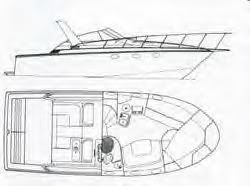
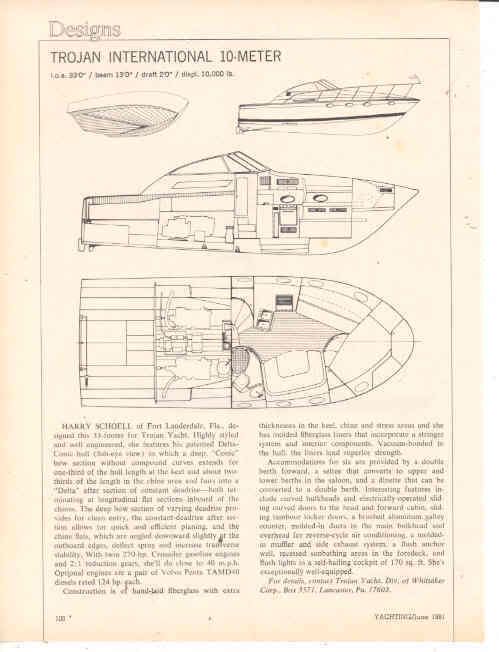
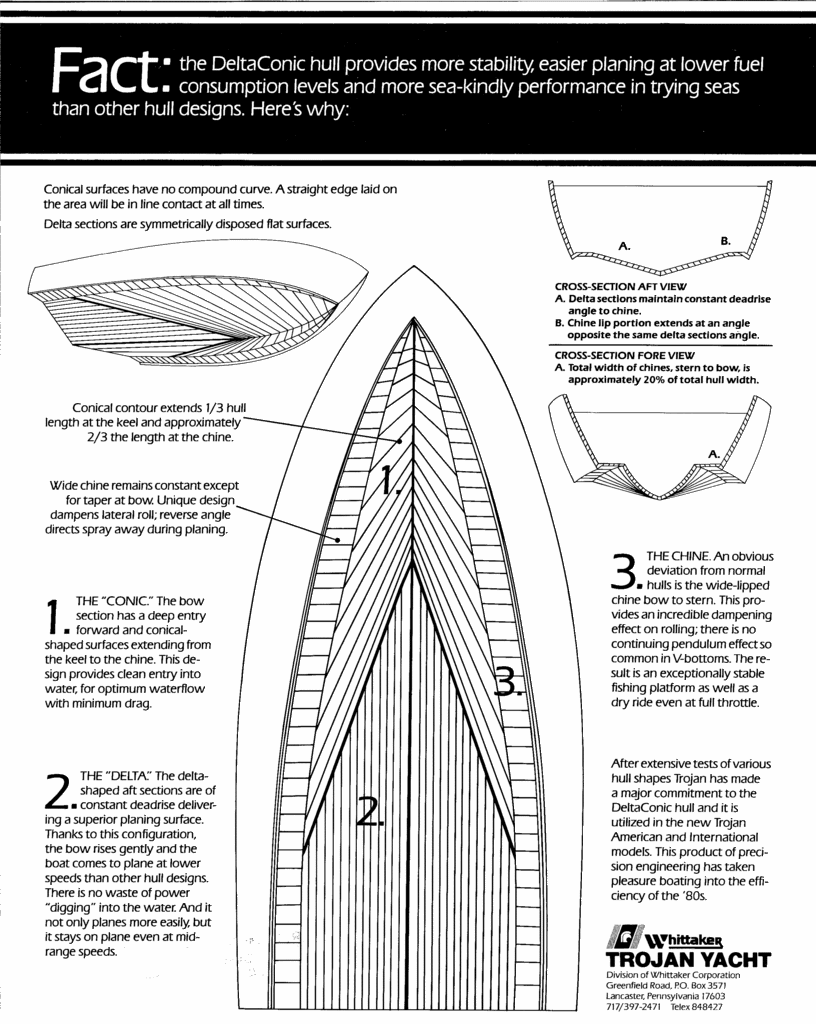
Friends who have been out on my 10 meter have compared her ride to that of a 40' vessel. Her 13' beam makes for an extraordinary amount of usable space.
You're getting a high quality design, engineering and build for a reasonable price.
The most expensive part of boating is depreciation, a cost you'lll not likely experience.
Here's some additional information.
I'm looking at boats in your same size range. Our list look almost identical except your missing the 35' Formula.
Here is a link to one in your year range and area. http://www.tiny.cc/pPEfG
Here is a link to one in your year range and area. http://www.tiny.cc/pPEfG
Scott-seems like a nice deal on that boat if it surveys well. You can probably get it for $25k or less. Trojans are well made boats. One of the charter captains who docks across from me has a 1972 32' SF Trojan and runs the heck out of it with very little problems over the years. The 31' Trojan I had was a woodie and a very solid boat. If I could have a larger boat I would look at the 10 meter very seriously. I lookedfor an 8.6 but didn't find a good one when I was buying.
- Joined
- Jan 1, 2000
- RO Number
- 3223
- Messages
- 640
My hands down favorite Trojan is the 10.8 meter sedan/convertible. Fantastic boat, and it only draws 2.5 feet!
In waters where a 58 Hatteras just will not fit, the Trojan 10.8 and Jersey 36 are my two favorite SF/cruisers.
Even David Pascoe likes the 10.8!!!!
In waters where a 58 Hatteras just will not fit, the Trojan 10.8 and Jersey 36 are my two favorite SF/cruisers.
Even David Pascoe likes the 10.8!!!!
Thanks for all the information. RWS, I may have some questions as I explore further. I also saw a lot of your postings on the Trojan Forum.
I may take a second look at the Formula 35 as well. I'll have to see if there are any in our area. One thing I like about the 10 meter, though is a I get a big boat with a smaller length . With everythig evaluated by the foot, it's a minor consideration, but does save a little $$
I may take a second look at the Formula 35 as well. I'll have to see if there are any in our area. One thing I like about the 10 meter, though is a I get a big boat with a smaller length . With everythig evaluated by the foot, it's a minor consideration, but does save a little $$
- Joined
- Feb 1, 2007
- RO Number
- 25075
- Messages
- 1,698
Before doing the repower, I thought about moving up from the 10 meter. I'd actually have to move up to a 40' in another vessel as a 36 - 38' Brand X has the equivalent space that I have on the 10 Meter.
I have a friend with an 11 Meter, Really nice vessel.
In the age you are looking at, condition and care by the previous owner are important, as is a good survey. The 11, 12, 13 & 14 meter Internationals all had a balsa core bottom. The ten has a solid fiberglass bottom.
There are 4 longitidunal stringers which are hollow. These are made intregal into the hull and liner, another innovation way before it's time as well as the arch and curved windshield.
There are three bulkheads on this vessel which help make her so tough.
I bought mine from the original owner. He lived in Miami and ran her over to the Islands several times a year. He had her for 18 years. That says something about this boat.
Good luck with your search. If you find one in good condition you can't go wrong with a Ten Meter International. Check out the Pascoe website as well.
RWS
I have a friend with an 11 Meter, Really nice vessel.
In the age you are looking at, condition and care by the previous owner are important, as is a good survey. The 11, 12, 13 & 14 meter Internationals all had a balsa core bottom. The ten has a solid fiberglass bottom.
There are 4 longitidunal stringers which are hollow. These are made intregal into the hull and liner, another innovation way before it's time as well as the arch and curved windshield.
There are three bulkheads on this vessel which help make her so tough.
I bought mine from the original owner. He lived in Miami and ran her over to the Islands several times a year. He had her for 18 years. That says something about this boat.
Good luck with your search. If you find one in good condition you can't go wrong with a Ten Meter International. Check out the Pascoe website as well.
RWS

- Joined
- Jan 1, 2000
- RO Number
- 2612
- Messages
- 832
If I'm not mistaken the 11, 12, and 13 Meter had balsa-cored hulls, except around thru-hull fittings, at those locations solid fiberglass was used.
- Joined
- Dec 25, 2006
- RO Number
- 24665
- Messages
- 137
the 10 meter gives a lot of bang for your buck,get a survay and you cant go wrong.
Hmm, for you 10 meter owners out there.
I am getting an insurance quote and this boat seesm to be in a bit of a donut hole. At least as far as USAA goes.
For older boast (15 years plus)they insure up to $20,000 from one company and $50,000 and up on another. As nice as the boat is, I don't know if it would survey at $50,000, but I could be wrong.
I am getting an additional quote from BoatUS, but my concern is getting enough insurance to cover the value of the boat, and any liens I may need.
Does anyone have examples of their insurance values? RWS, with Diesels, I'm sure you are well above $50K
I am getting an insurance quote and this boat seesm to be in a bit of a donut hole. At least as far as USAA goes.
For older boast (15 years plus)they insure up to $20,000 from one company and $50,000 and up on another. As nice as the boat is, I don't know if it would survey at $50,000, but I could be wrong.
I am getting an additional quote from BoatUS, but my concern is getting enough insurance to cover the value of the boat, and any liens I may need.
Does anyone have examples of their insurance values? RWS, with Diesels, I'm sure you are well above $50K
- Joined
- Dec 25, 2006
- RO Number
- 24665
- Messages
- 137
Try american family, $60,000- very reasonable, It beat Boatus.